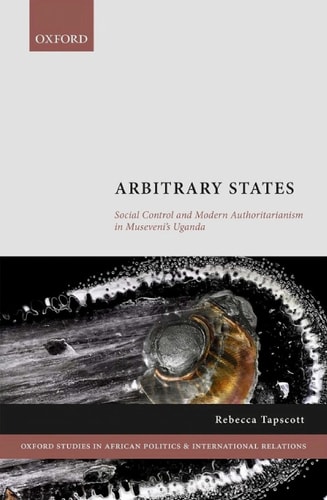
Arbitrary States: Social Control and Modern Authoritarianism in Museveni's Uganda
0
0
As an Amazon Associate and affiliate partner, Menrva Books earns from qualifying purchases. Learn more
Author Description
In recent years, scholars have noted the rise of a particular type of authoritarianism worldwide, in which rulers manipulate institutions designed to implement the rule of law so that they instead facilitate the exercise of arbitrary power. Even as scholars puzzle over this seemingly new phenomenon, scholarship on African politics offers helpful answers. This book places literature on the post-colonial African state in conversation with literature on modern authoritarianism, using this to frame over ten months of qualitative field research on Uganda's informal security actors - including vigilante groups, local militias, and community police. Based on this research, the book presents an original framework - called 'institutionalized arbitrariness' - to explain how modern authoritarian rulers project arbitrary power even in environments of relatively functional state institutions, checks and balances and the rule of law. In regimes characterized by institutionalized arbitrariness, the state's stochastic assertions and withdrawals of power inject unpredictability into the political relationship between both local authorities and citizens. This arrangement makes it difficult for citizens to predict which authority, if any, will claim jurisdiction in a given scenario, and what rules will apply. This environment of pervasive political unpredictability limits space for collective action and political claim-making, while keeping citizens marginally engaged in the democratic process. The book is grounded in empirical research and literature theorizing the African state, while seeking to inform a broader debate about contemporary forms of authoritarianism, state-building, and state consolidation. Oxford Studies in African Politics and International Relations is a series for scholars and students working on African politics and International Relations and related disciplines. Volumes concentrate on contemporary developments in African political science, political economy, and
Menrva's Summary
THE THESIS
How do modern authoritarian regimes maintain control by manipulating institutions to exercise arbitrary power rather than the rule of law? Tapscott, a researcher specializing in African politics, utilizes ten months of qualitative field research in Uganda to analyze the intersection of post-colonial state structures and contemporary authoritarian tactics. She introduces the framework of 'institutionalized arbitrariness' to explain how rulers create systemic unpredictability, effectively discouraging collective action while maintaining a facade of democratic engagement.
THE SCOPE MAP
What You Will Find
- Analysis of informal security actors including vigilante groups, local militias, and community police.
- The 'institutionalized arbitrariness' theoretical framework for understanding state power.
- Qualitative field research conducted within the Ugandan political landscape.
Scope Limits
- The study focuses specifically on the Ugandan context and may not be universally applicable to all global authoritarian regimes without further comparative analysis.
- The research does not provide a comprehensive history of the Museveni administration but rather focuses on the mechanics of social control.
THE AUTHORITY PERSPECTIVE
Scholars in African politics and international relations identify this work as a significant contribution to the study of state consolidation and informal security structures. Readers frequently note the academic density of the prose, which is intended for an audience of political scientists and students of governance.
Page Count:
248
Publication Date:
2021-01-01
Publisher:
OUP Oxford
ISBN-10:
0192598473
ISBN-13:
9780192598479
State Building
Sociology
Authoritarianism
International relations
Community Tags
Other Editions(2)
Similar Books









Reader Comments
Share Your Thoughts
No comments yet. Be the first to share your thoughts!