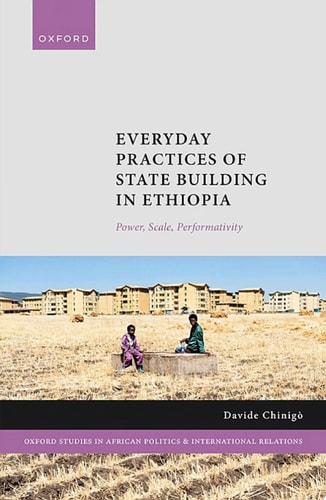
Everyday Practices of State Building in Ethiopia: Power, Scale, Performativity
0
0
As an Amazon Associate and affiliate partner, Menrva Books earns from qualifying purchases. Learn more
Author Description
Everyday practices of state building interrogates the question about how to reinstate movement to our conceptualisation of state formation in Africa at a time in which the continent witnesses profound social and political transformations inscribed in increasingly globalised and localised dynamics. The book revisits key theories of the state adopting a detailed empirical approach that studies how state power operates in the everyday. It locates the mutual constitution of state and society in the wide set of scalar processes that articulate how state power structures social life and, simultaneously, creates the conditions of possibility for new openings and social formations. Drawing on five qualitative fieldworks in Ethiopia between 2006 and 2018, the book identify some important challenges that the ruling Ethiopian Peoples' Revolutionary Democratic Front (EPRDF) has encountered in institutionalising power through the developmental state, an ambitious model of state-mediated economic liberalisation intended to fulfil the broader re-organisation of the Ethiopian state along Ethnic Federalism since 1991. The case studies discuss how policies of resettlement, decentralisation, agriculture commercialisation, entrepreneurship, and industrialisation, inscribed dynamics of inclusion and exclusion in both rural and urban areas. Against these profound transformations beneficiaries casted new meanings to land, place, and work along struggles to secure reproduction. Interrogating the notions of scale and performativity, the book revisits dominant approaches that in African studies read state formation along centre-periphery relations, and ascribe cultural interpretations to the work of state power in the everyday, ultimately contributing to important discussions about authoritarianism and ethnonationalism in contemporary Ethiopia. Oxford Studies in African Politics and International Relations is a series for scholars and students working on African politics and International Relations.
Menrva's Summary
THE THESIS
This book investigates how state power in Ethiopia is constructed and maintained through everyday practices, challenging static conceptualizations of state formation in Africa. Davide Chinigò, a scholar specializing in African politics, utilizes a framework of scale and performativity to analyze the interaction between the state and society. By examining the developmental state model under the Ethiopian Peoples' Revolutionary Democratic Front (EPRDF), the author argues that state power is not merely top-down but is mutually constituted through localized social dynamics and institutional policies.
THE SCOPE MAP
What You Will Find
- Analysis of the developmental state model and Ethnic Federalism in Ethiopia since 1991.
- Examination of specific policy areas including resettlement, decentralization, agricultural commercialization, entrepreneurship, and industrialization.
- Theoretical application of scale and performativity to African state formation.
Scope Limits
- The study focuses primarily on the period between 2006 and 2018.
- It does not provide a comprehensive history of the entire Ethiopian state, focusing instead on the specific institutionalization efforts of the EPRDF.
THE AUTHORITY PERSPECTIVE
Scholars in the field of African politics identify this work as a significant contribution to the study of authoritarianism and ethnonationalism in the Horn of Africa. Readers frequently note the academic density of the prose and the rigorous empirical foundation provided by the author's extensive fieldwork.
Page Count:
442
Publication Date:
2022-01-01
Publisher:
OUP Oxford
ISBN-10:
0192696645
ISBN-13:
9780192696649
State Building
Ethiopian History
International relations
Sociology
Community Tags
Similar Books