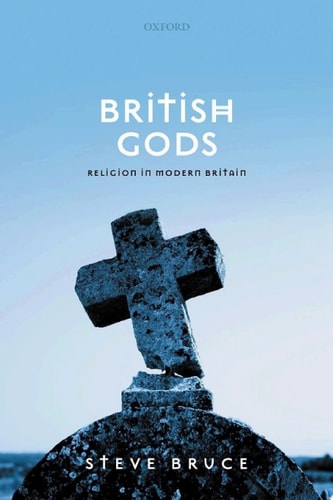
British Gods: Religion in Modern Britain
0
0
As an Amazon Associate and affiliate partner, Menrva Books earns from qualifying purchases. Learn more
Author Description
The big picture is well-known: over the last century, religion in Britain has lost power, popularity, and plausibility. Here, Steve Bruce charts the quantifiable changes in religious interest and observance over the last fifty years by returning to a number of towns and villages that were the subject of detailed community studies in the 1950s and 1960s, to see how the status and nature of religion has changed. Drawing on both detailed data on baptism rates, church weddings, church attendance and the like, and on his extensive fieldwork, he considers the broader picture of religion today: the status of the clergy, the churches' attempts to find new roles, links between religion and violence, and the impact of the charismatic movement. Along the way, Bruce encounters and engages with the contemporary rise of secularism, considering our everyday secular tensions with religion: arguments over moral issues such as abortion and gay rights, the effect of social class on belief, the impact of religion on British politics, and the ways that local social structures strengthen or weaken religion. Analysing the obstacles to any religious revival, he explores how the current stock of religious knowledge is so depleted, religion so unpopular, and committed believers so scarce that any significant reversal of religion's decline in Britain is unlikely.
Menrva's Summary
THE THESIS
This work investigates the decline of religious power, popularity, and plausibility in Britain over the last century. Steve Bruce, a sociologist specializing in the secularization thesis, utilizes a comparative methodology by revisiting specific towns and villages previously studied in the 1950s and 1960s. By contrasting historical community data with contemporary fieldwork, he argues that the depletion of religious knowledge and the scarcity of committed believers make a significant religious revival in Britain highly improbable.
THE SCOPE MAP
What You Will Find
- Longitudinal analysis of baptism rates, church weddings, and attendance figures.
- Qualitative fieldwork regarding the status of the clergy and church adaptation.
- Examination of the intersection between religion, politics, and social class.
- Discussion of secular tensions surrounding moral issues like abortion and gay rights.
Scope Limits
- The analysis is geographically restricted to the United Kingdom.
- The study focuses primarily on the decline of institutional religion rather than private spirituality.
THE AUTHORITY PERSPECTIVE
Sociologists and historians frequently cite this text as a rigorous empirical defense of the secularization thesis within the British context. Readers often note the academic density of the prose and the author's uncompromising stance on the unlikelihood of religious resurgence.
Page Count:
298
Publication Date:
2020-01-01
Publisher:
OUP Oxford
ISBN-10:
0192595954
ISBN-13:
9780192595959
History
Religion
Religion and sociology
British History
Sociology
Social Science
Secularism
Community Tags
Similar Books