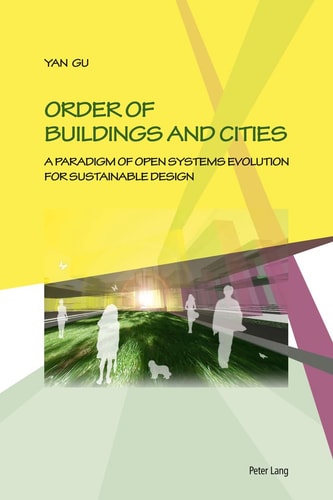
Order of Buildings and Cities: A Paradigm of Open Systems Evolution for Sustainable Design
0
0
As an Amazon Associate and affiliate partner, Menrva Books earns from qualifying purchases. Learn more
Author Description
The assumption of an environmental crisis, e.g. global warming and climate change, has put into question the viability of the modern development pattern, especially in industrialised societies since the Industrial Revolution. This pattern is charactered by excessive exploitation of energy and resources without concern for negative impact upon the natural ecosystem. One of primary challenges to sustainable development is identified as the dilemma between long term economic development and environmental damage, composed of temporal, social, economic, environmental, cultural and technological dimensions. Influenced by this industrial pattern, modern design of buildings and cities contributes to environmental degradation. To explore an alternative paradigm for sustainable design, a model of open systems evolution is investigated based on the scientific foundations of the Second Law of Thermodynamics and complex systems science. As a manifesto of the Post-Modernism world-view, this new paradigm states that the creativity of the universe appears as the emergence of order or organised complexity via the mechanisms of open systems evolution. An open system spontaneously adapts to its host environment via gradients and uses inputs of energy and resources for its evolution towards order, which is supported by an internal structure through self-organisation, minimising negative impact and optimising compatibility with the host environment as measured by entropy. The paradigm of open systems evolution implies a design frame-work for sustainable co-existence of man and nature, which directly impacts institutional education and design practice for the built environment. Technically, it suggests an intelligent model of sustainable design, in which, order is interpreted as the sustainable symbiosis of nature, buildings and cities.
Menrva's Summary
THE THESIS
This book investigates an alternative paradigm for sustainable design by examining the evolution of open systems. It posits that the universe's creativity manifests as organized complexity through open systems evolution, which adapt to their environment by using energy and resources to evolve towards order, minimizing negative impacts and optimizing compatibility. This paradigm offers a framework for the sustainable coexistence of humans and nature, impacting education and design practices for the built environment.
THE SCOPE MAP
- An analysis of the environmental crisis and the limitations of the modern development pattern.
- An exploration of the dilemma between long-term economic development and environmental damage.
- The application of Second Law of Thermodynamics and complex systems science to design.
- A proposed paradigm of open systems evolution for sustainable design.
- The concept of 'organized complexity' as a manifestation of universal creativity.
- A framework for sustainable coexistence of humans and nature.
- Implications for institutional education and design practice in the built environment.
THE AUTHORITY PERSPECTIVE
The book presents a theoretical framework for sustainable design, drawing on principles of thermodynamics and complex systems science. It critiques the prevailing development model and proposes an alternative based on the concept of open systems evolution. The work aims to provide a new perspective on how buildings and cities can achieve a symbiotic relationship with nature, influencing educational and professional practices in the field of architecture and urban planning.
Page Count:
221
Publication Date:
2011-01-01
Publisher:
Peter Lang
ISBN-10:
3034306210
ISBN-13:
9783034306218
Non-Fiction
Science
Architecture
urban planning
Systems Theory
Sustainability
Community Tags
Similar Books