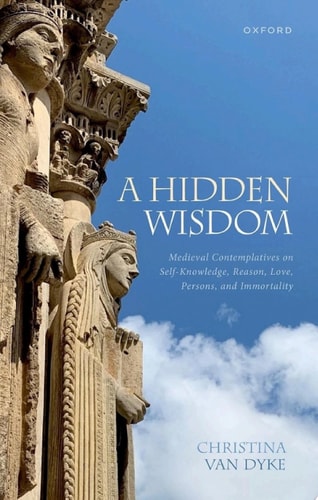
A Hidden Wisdom: Medieval Contemplatives on Self-Knowledge, Reason, Love, Persons, and Immortality
0
0
As an Amazon Associate and affiliate partner, Menrva Books earns from qualifying purchases. Learn more
Author Description
Medieval philosophy is primarily associated today with university-based disputations and the authorities cited in those disputations. In their own time, however, scholastic debates were recognized as just one part of wide-ranging philosophical and theological discussions. A Hidden Wisdom breaks new ground by drawing attention to another crucial component of these conversations: the Christian contemplative tradition.The period from 1200 to 1500, in particular, saw a dramatic increase in the production and consumption of mystical and contemplative literature in the 'Christian West', by laypeople as well as religious scholars, women as well as men. A Hidden Wisdom focuses on five topics of particular interest to both scholastics and contemplatives in this period, namely, self-knowledge, reason and its limits, love and the will, persons, and immortality and the afterlife. This focus centers the (often overlooked) contributions of medieval women and demonstrates that when we re-unite scholasticism with its contemplative counterpart, we gain not only a more accurate understanding of the scope of medieval Christian philosophy and theology but also an increased awareness of a deeply practical tradition that builds up as well as tears down, generates as well as deconstructs.The book's treatment of topics and figures is meant to be representative rather than exhaustive: a tasting menu, rather than a comprehensive study. The choice of topics offers a series of 'hooks' for philosophers to connect their own interests to issues central to medieval contemplative philosophy, while also providing medievalists in other disciplines a fresh lens through which to view these texts.
Menrva's Summary
THE THESIS
This book investigates the philosophical contributions of the medieval Christian contemplative tradition, arguing that it serves as a vital, often overlooked counterpart to academic scholasticism. Christina Van Dyke, a scholar of medieval philosophy, utilizes a thematic framework to bridge the gap between mystical literature and formal university disputations. By examining texts from 1200 to 1500, she demonstrates how contemplative writers engaged with rigorous questions regarding the human condition, reason, and the nature of the soul.
THE SCOPE MAP
What You Will Find
- Analysis of five core philosophical themes: self-knowledge, reason, love, personhood, and immortality.
- Integration of works by both male and female medieval contemplatives.
- A comparative methodology that links mystical insights with scholastic debates.
Scope Limits
- The text functions as a representative survey rather than an exhaustive historical encyclopedia.
- It focuses specifically on the Christian West between 1200 and 1500.
THE AUTHORITY PERSPECTIVE
Scholars and students of medieval thought frequently highlight this work for its success in expanding the canon of medieval philosophy beyond university-based scholasticism. The text is noted for its accessible, thematic structure, which provides a clear entry point for those interested in the intersection of theology and philosophical inquiry.
Page Count:
256
Publication Date:
2022-01-01
Publisher:
OUP Oxford
ISBN-10:
0192606166
ISBN-13:
9780192606167
Philosophy
History & Surveys
History of Ideas
English
Christian mysticism
Theology
English & College Success
Community Tags
Similar Books