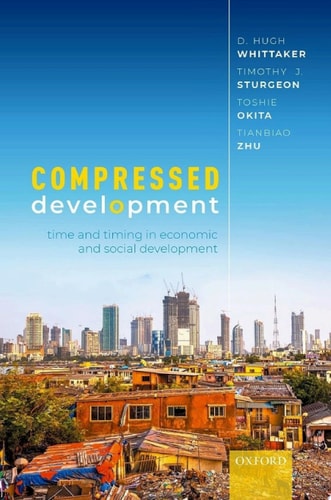
Compressed Development: Time and Timing in Economic and Social Development
0
0
As an Amazon Associate and affiliate partner, Menrva Books earns from qualifying purchases. Learn more
Author Description
This book proposes a new way to approach comparative international development by focusing on time and timing in economic and social development. The UK industrialized over two centuries, and then started to de-industrialize in the late 1960s. Today, the most rapid developers experience aspects of industrialization and de-industrialization simultaneously. It is no longer clear that industrialization offers the path of growth it once did; industrialization has become 'thin.' Demographic and social challenges that earlier developers faced sequentially now come at the same time. Rapid growers experience compression most acutely, but the spatial and temporal fusing of past and present is widespread, affecting high-, middle-, and lower-income countries alike. Timing refers to the differences in historical periods in which development takes place. The geopolitical, institutional and technological environment for countries recently integrated into the global economy has been vastly different from that of the preceding postwar decades of 'embedded liberalism,' although it does contain echoes of the 'first globalization' and 'first financialization' a century ago. The first era of liberalism did not end well, and the second is similarly foundering on the rocks of nationalism and protectionism, as it is being battered by a global pandemic. The authors propose an interdisciplinary conceptual framework based on co-evolving state-market and organization-technology dyads, which will help readers make sense of contemporary development across multiple societies, sectors and geographies, and provide a template for historical comparison.
Menrva's Summary
THE THESIS
This book investigates how the compression of historical development timelines alters the economic and social trajectories of modern nations. The authors, a team of interdisciplinary scholars, utilize a comparative framework to analyze how contemporary rapid-growth economies face industrialization, de-industrialization, and demographic shifts simultaneously rather than sequentially. By examining the co-evolution of state-market and organization-technology dyads, the text provides a structured method for understanding the challenges of development in an era of shifting geopolitical and technological landscapes.
THE SCOPE MAP
What You Will Find
- A conceptual framework for analyzing temporal and spatial overlaps in development.
- Comparative analysis of industrialization patterns across different historical periods.
- Examination of the impact of globalized trade, nationalism, and protectionism on development outcomes.
Scope Limits
- The text does not provide a prescriptive policy manual for individual nations.
- It does not offer exhaustive case studies for every developing economy globally.
THE AUTHORITY PERSPECTIVE
Experts identify this work as a significant contribution to development studies, particularly for its focus on the temporal dimensions of economic growth. Readers frequently note the academic density of the prose and the utility of the proposed interdisciplinary framework for comparative research.
Page Count:
295
Publication Date:
2020-01-01
Publisher:
OUP Oxford
ISBN-10:
0192609475
ISBN-13:
9780192609472
Economics
Economic History
Globalization
Sociology
International Development
Community Tags
Similar Books