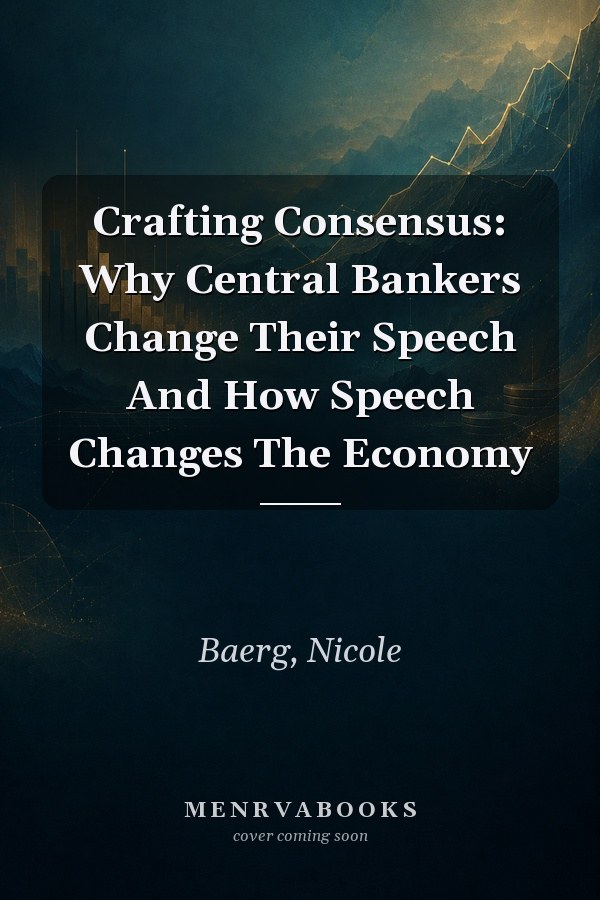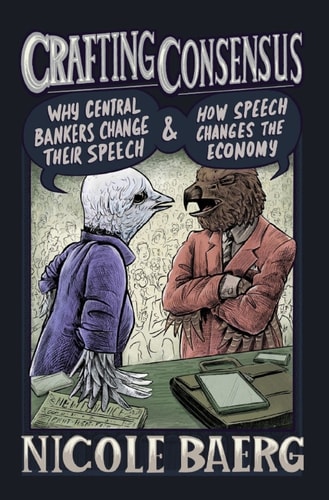
Crafting Consensus: Why Central Bankers Change Their Speech and How Speech Changes the Economy
0
0
As an Amazon Associate and affiliate partner, Menrva Books earns from qualifying purchases. Learn more
Author Description
In a world dependent on the constant sharing of information, central bankers increasingly communicate their policies to the mass public. Central bank communications are drafted in monetary policy committee meetings composed of policymakers with differing interests. Despite their differences, committee members must come together, write, and agree to an official policy statement. Once released to the public, central bank communications then affect citizens' actions and ultimately, the economy. But how exactly does this work? In Crafting Consensus, Nicole Baerg explains how the transparency of central bank communication depends on the configuration of committee members' preferences. Baerg argues that monetary policy committees composed of members with differing preferences over inflation are better suited to communicating precise information with the public. These diverse committees produce central bank statements of higher quality and less uncertainty than those from more homogeneous committees. Additionally, she argues that higher quality statements more effectively shape individuals' inflation expectations and move the economy in ways that policymakers intend. Baerg demonstrates that central bankers are not impartial technocrats and that their preferences and the institutional rules where they work matter for understanding the politics of monetary policy and variations in economic performance over time.Conducting empirical analysis from historical archival data, textual analysis, machine-learning, survey experiments, and cross-sectional time-series data, Crafting Consensus offers a new theory of committee decision making and a battery of empirical tests to provide a rich understanding of modern-day central banking.
Menrva's Summary
THE THESIS
This book investigates how the internal composition of monetary policy committees influences the clarity of central bank communications and the subsequent impact of those communications on public inflation expectations. Nicole Baerg, a scholar in political economy, utilizes a framework that treats central bankers as political actors with distinct preferences rather than impartial technocrats. By analyzing the intersection of institutional rules and individual member interests, the author argues that committees with diverse preferences produce higher-quality, less ambiguous policy statements that more effectively guide economic behavior.
THE SCOPE MAP
What You Will Find
- A theoretical model of committee decision-making based on member preference heterogeneity.
- Empirical analysis using historical archival data and textual analysis of policy statements.
- Application of machine-learning techniques to quantify communication quality.
- Survey experiments measuring the impact of central bank statements on individual inflation expectations.
Scope Limits
- The analysis focuses primarily on the relationship between committee composition and communication output rather than the broader geopolitical factors influencing central banks.
- The study does not provide a comprehensive history of every global central bank, focusing instead on the mechanics of committee-based policy drafting.
THE AUTHORITY PERSPECTIVE
Experts recognize this work as a significant contribution to the political economy of central banking by bridging the gap between institutional design and communication outcomes. Readers frequently note the technical rigor of the methodology, which combines qualitative archival research with advanced quantitative data analysis.
Page Count:
217
Publication Date:
2020-01-01
Publisher:
Oxford University Press
ISBN-10:
0190499508
ISBN-13:
9780190499501
Economics
Humanities
Public Policy
Money & BankingMonetary Theory
Communication Studies
Communication in financial institutions
Music History
Community Tags
Similar Books