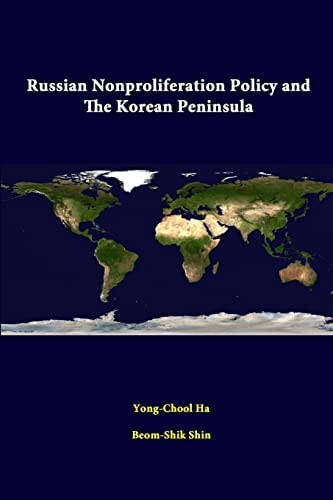
Russian Nonproliferation Policy and the Korean Peninsula
0
0
As an Amazon Associate and affiliate partner, Menrva Books earns from qualifying purchases. Learn more
Author Description
Russia is one of the members of the six-party talks on North Korean nuclearization, but its views on how to deal with this problem do not agree with those of the U.S. Government. This signifies a gap between Moscow and Washington over the proper way to deal with proliferation and represents a change from the earlier pattern of bilateral cooperation in 1987-96 that led to significant achievements in the field of arms control and nonproliferation. We may attribute the major differences between Moscow and Washington to several factors, but two stand out here. One is that Moscow prefers a different model of resolving proliferation issues than Washington apparently does. Moscow's preferred option is the so-called Ukrainian model, whereby the proliferating state is induced to relinquish its pursuit of nuclear weapons through a multilateral negotiation in which it receives both economic compensation and security guarantees from its partners.
Menrva's Summary
THE THESIS
This book investigates the divergence between Russian and U.S. approaches to nuclear nonproliferation, particularly concerning the Korean Peninsula. The work examines the differing models favored by Moscow and Washington for resolving proliferation issues, highlighting Russia's preference for a multilateral negotiation approach that includes economic compensation and security guarantees, exemplified by the 'Ukrainian model.' It contrasts this with U.S. policy and analyzes the factors contributing to this strategic gap, noting a shift from earlier patterns of bilateral cooperation in arms control.
THE SCOPE MAP
- Analysis of Russia's role in the six-party talks on North Korean nuclearization.
- Comparison of Russian and U.S. nonproliferation strategies.
- Detailed examination of the 'Ukrainian model' for resolving proliferation issues.
- Exploration of economic compensation and security guarantees as nonproliferation incentives.
- Historical context of bilateral cooperation in arms control between Russia and the U.S. (1987-1996).
- Identification of key factors contributing to the divergence in Moscow-Washington policy.
THE AUTHORITY PERSPECTIVE
The book's analysis of Russian nonproliferation policy, particularly in the context of the Korean Peninsula, offers a distinct perspective that contrasts with U.S. governmental views. It highlights a strategic divergence rooted in differing preferred models for resolving proliferation issues, with Russia advocating for a compensation and security guarantee-based approach. The work provides historical context by referencing earlier successful bilateral cooperation in arms control, suggesting a shift in international dynamics. This detailed examination is likely to be of interest to specialists in international relations and security studies.
Page Count:
48
Publication Date:
2014-06-22
Publisher:
Lulu Press, Incorporated
ISBN-10:
1312298693
ISBN-13:
9781312298699
Non-Fiction
Politics
Foreign Policy
Security Studies
International relations
Community Tags
Similar Books