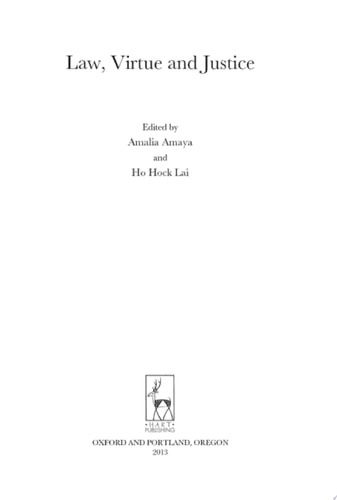
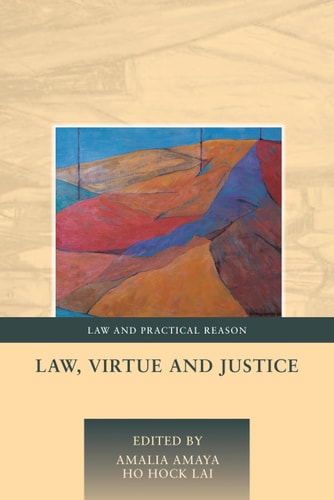
Law, Virtue and Justice
0
0
As an Amazon Associate and affiliate partner, Menrva Books earns from qualifying purchases. Learn more
Author Description
This book explores the relevance of virtue theory to law from a variety of perspectives. The concept of virtue is central in both contemporary ethics and epistemology. In contrast, in law, there has not been a comparable trend toward explaining normativity on the model of virtue theory. In the last few years, however, there has been an increasing interest in virtue theory among legal scholars. 'Virtue jurisprudence' has emerged as a serious candidate for a theory of law and adjudication. Advocates of virtue jurisprudence put primary emphasis on aretaic concepts rather than on duties or consequences. Aretaic concepts are, on this view, crucial for explaining law and adjudication. This book is a collection of essays examining the role of virtue in general jurisprudence as well as in specific areas of the law. Part I puts together a number of papers discussing various philosophical aspects of an approach to law and adjudication based on the virtues. Part II discusses the relationship between law, virtue and character development, with some of the essays selected analysing this relationship by combining both eastern perspectives on virtue and character with western approaches. Parts III and IV examine problems of substantive areas of law, more specifically, criminal law and evidence law, from within a virtue-based framework. Last, Part V discusses the relevance of empathy to our understanding of justice and legal morality.--Bloomsbury Publishing.
Menrva's Summary
THE THESIS
This book investigates the under-explored connection between virtue theory and legal scholarship. While virtue theory is prominent in ethics and epistemology, its application to law has been historically limited. However, recent years have seen a surge of interest in 'virtue jurisprudence,' which emphasizes aretaic concepts over duties or consequences to explain law and adjudication. This collection of essays explores this emerging field from various philosophical and practical standpoints.
THE SCOPE MAP
- Philosophical underpinnings of virtue jurisprudence.
- The relationship between law, virtue, and character development, including Eastern and Western perspectives.
- Applications of virtue-based frameworks to criminal law.
- Analysis of evidence law through a virtue-based lens.
- The relevance of empathy to justice and legal morality.
THE AUTHORITY PERSPECTIVE
The collection presents a comprehensive examination of virtue theory's application to law, drawing on diverse philosophical and legal scholarship. It highlights the growing trend of 'virtue jurisprudence' among legal academics, offering a counterpoint to traditional duty- or consequence-based legal theories. The essays explore both theoretical foundations and practical applications across various legal domains, including criminal and evidence law. The inclusion of cross-cultural perspectives on virtue and character development enriches the discussion on justice and legal morality.
Page Count:
337
Publication Date:
2013-01-01
Publisher:
Hart Publishing
ISBN-10:
1472566297
ISBN-13:
9781472566294
Philosophy
Non-Fiction
Law
Virtue Theory
Ethics
Criminal Law
Jurisprudence
Evidence Law
Justice
Community Tags
Other Editions(3)
Similar Books