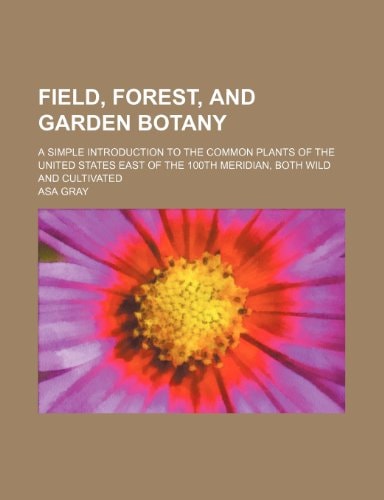
Field, Forest, and Garden Botany: A Simple Introduction to the Common Plants of the United States East of the 100th Meridian, Both Wild and Cultivated
0
0
As an Amazon Associate and affiliate partner, Menrva Books earns from qualifying purchases. Learn more
Author Description
This historic book may have numerous typos and missing text. Purchasers can download a free scanned copy of the original book (without typos) from the publisher. Not indexed. Not illustrated. 1895 edition. Excerpt:...Var. discolor, Gray. 3-6 high, branching and leafy, with rather small heads, and deeply pinnatifid leaves, green above, white beneath, their lobes narrow and prickly pointed. @ C. VirginisLnus, Pursh. Stems rather simple, l-3 high, ending in a long naked peduncle; leaves lanceolate and slightly or not at all pinnatifid; head small. 2Z Plains and barrens, Va., W. and S. 66. CYNARA, ARTICHOKE. (Ancient Greek name.) 2Z (p. 222.) C. Cardunculus, Linn. Cardoon. Leaves deeply and compoundly divided and prickly, the less fleshy scales of the head prickly-tipped; the fleshy leafstalks and midrib eaten after being blanched in the manner of celery. Strong thistle-like plants, 4-6. Eu. C. Sc6lymus, Artichoke, has less compound leaves, the ovate and usually pointless scales of the involucre and the receptacle of the young flower heads fleshy, and edible when cooked. A modification of the 67. CENTATJREA, CENTAUREA or STAR THISTLE. (Chiron the Centaur.) (p. 222.) Flowers all alike in the head, the marginal ones not enlarged and raylike; pappus of very short bristles; scales of head with dark-fringed appendage. C. nigra, Linn. Knapweed. A coarse weed, in fields and waste places E., nat. from Eu.; stem 2 high; leaves roughish, lance-oblong, the lower with some coarse teeth; flowers purple. 2£ » Marginal flowers more or less enlarged, forming a kind of false ray, and sterile; pappus of bristles; scales of head with fringed appendage. C. Cineraria, Linn. (or C. candmfssima). A low species, cult. from S. Eu., with very white-woolly twice-pinnatifid leaves, and purple flowers, the outermost little enlarged; not hardy N. % C. Cyanus, Linn. Bluerottle, Cornflower, Bachelor's Button. In gardens, from Eu., sparingly running wild; loosely cottony, with stem...
Menrva's Summary
THE THESIS
This book aims to provide a simple introduction to the common plants found in the eastern United States, covering both wild and cultivated species. Authored by Asa Gray, a prominent botanist, this work draws upon his extensive knowledge to classify and describe various flora. The text focuses on identification based on physical characteristics, using botanical terminology to detail leaf structures, flower heads, and overall plant form. It serves as a foundational guide for understanding the botanical landscape of the region.
THE SCOPE MAP
- What You Will Find:
- Detailed descriptions of common wild and cultivated plants east of the 100th meridian.
- Botanical classification and identification keys.
- Specific examples including variations of species like C. VirginisLnus and C. Cardunculus.
- Information on plant morphology, including leaf shape, stem structure, and flower characteristics.
THE AUTHORITY PERSPECTIVE
This 1895 edition, despite its historical significance in botany, is noted for potential transcription errors, with a disclaimer offering a typo-free scanned copy. The book's content is presented as a straightforward botanical guide, focusing on descriptive identification rather than theoretical concepts. Its value lies in its historical perspective on North American flora and its direct, descriptive approach to plant identification, suitable for those interested in the botanical studies of the late 19th century.
Page Count:
248
Publication Date:
2012-06-26
Publisher:
RareBooksClub.com
ISBN-10:
1236477103
ISBN-13:
9781236477101
Science
Non-Fiction
Botany
Field Guide
North America
Plants
Gardening
Community Tags
Similar Books



Reader Comments
Share Your Thoughts
No comments yet. Be the first to share your thoughts!