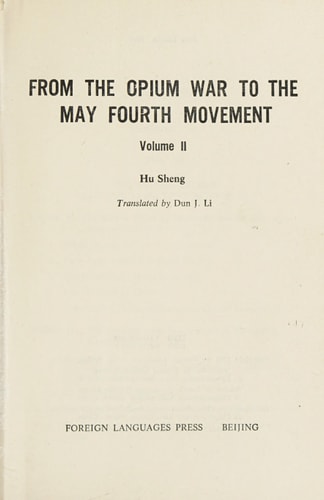
From the Opium War to the May Fourth Movement
0
0
As an Amazon Associate and affiliate partner, Menrva Books earns from qualifying purchases. Learn more
Author Description
From the Opium War to the May Fourth Movement, a major work by Hu Sheng, is the fruit of years of research on modern Chinese history. The book is written in five parts, with 27 chapters in all, and carries a preface. The author analyzes modern Chinese history in terms of three waves of revolution. In Part I, he writes about the Opium War and the Taiping Peasant Revolution, the first wave of revolution; in Part II, about the formation of a semicolonial and semifeudal regime, which was ultimately to lead to a new wave of revolution; in Part III, about the Reform Movement of 1898 and the Yi He Tuan (Boxer) Movement, which was the second wave of revolution; in Part IV, about the Bourgeois Revolution of 1911, the third wave of revolution; and in Part V, about the transition toward the New-Democratic Revolution that led China out of darkness. Using primary sources, this book analyzes the key events in modern Chinese history, and reflects the Chinese people's struggle against foreign aggressors and their own feudal rulers as they fought for national independence, democracy and freedom from 1840 to 1919. Following his earlier work Imperialism and Chinese Politics, this book is yet another contribution by Hu Sheng to the study of modem Chinese history.
Menrva's Summary
THE THESIS
This book analyzes modern Chinese history through the lens of three waves of revolution, charting the nation's struggle for independence from 1840 to 1919. Hu Sheng, a noted historian, meticulously examines key events and movements, including the Opium War, the Taiping Rebellion, the Reform Movement of 1898, the Boxer Rebellion, and the Revolution of 1911. The work is structured into five parts and 27 chapters, utilizing primary sources to explore China's transition from a semicolonial and semifeudal state towards a new democratic revolution. It reflects the Chinese people's persistent fight against foreign aggression and internal feudal oppression in their pursuit of national sovereignty, democracy, and freedom.
THE SCOPE MAP
- Analysis of modern Chinese history from 1840 to 1919.
- Examination of three distinct waves of revolution.
- Detailed coverage of the Opium War and the Taiping Peasant Revolution (First Wave).
- Discussion of the formation of a semicolonial and semifeudal regime.
- Analysis of the Reform Movement of 1898 and the Yi He Tuan (Boxer) Movement (Second Wave).
- Exploration of the Bourgeois Revolution of 1911 (Third Wave).
- Reflection on the transition towards the New-Democratic Revolution.
THE AUTHORITY PERSPECTIVE
Hu Sheng's "From the Opium War to the May Fourth Movement" is recognized as a significant contribution to the study of modern Chinese history, built upon years of dedicated research. The book's analytical framework, which divides the period into three waves of revolution, offers a structured approach to understanding China's complex historical trajectory. Its reliance on primary sources lends authority to its examination of pivotal events and the persistent struggle for national independence and democracy. The work is considered a major contribution by Hu Sheng, following his earlier influential text on imperialism and Chinese politics.
Page Count:
702
Publication Date:
1991-01-01
Publisher:
Foreign Languages Press
ISBN-10:
0835121615
ISBN-13:
9780835121613
History
Non-Fiction
Chinese History
Modern History
Community Tags
Similar Books