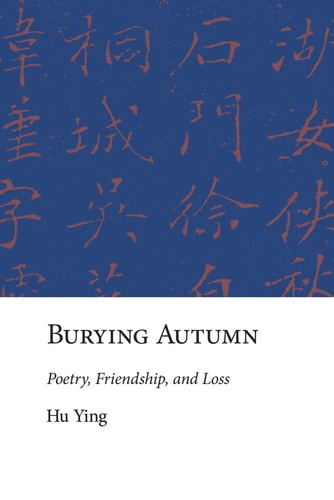
Burying Autumn: Poetry, Friendship, and Loss
0
0
As an Amazon Associate and affiliate partner, Menrva Books earns from qualifying purchases. Learn more
Author Description
Autumn wind, autumn rain, fill my heart with sorrow"-these were the last words of Qiu Jin (1875-1907), written before she was beheaded for plotting to overthrow the Qing empire. Eventually, she would be celebrated as a Republican martyr and China's first feminist, her last words committed to memory by schoolchildren. Yet during her lifetime she was often seen as eccentric, even deviant; in her death, and still more in the forced abandonment of her remains, the authorities had wanted her to disappear into historical oblivion. Burying Autumn tells the story of the enduring friendship between Qiu Jin and her sworn-sisters Wu Zhiying and Xu Zihua, who braved political persecution to give her a proper burial. Formed amidst social upheaval, their bond found its most poignant expression in Wu and Xu's mourning for Qiu. The archives of this friendship-letters, poems, biographical sketches, steles, and hand-copied sutra-vividly display how these women understood the concrete experiences of modernity, how they articulated those experiences through traditional art forms, and how their artworks transformed the cultural traditions they invoked even while maintaining deep cultural roots. In enabling Qiu Jin to acquire historical significance, their friendship fulfilled its ultimate socially transformative potential.
Menrva's Summary
THE THESIS
The enduring legacy of a revolutionary martyr is shaped by the clandestine efforts of her devoted friends. Burying Autumn chronicles the profound friendship between Qiu Jin, a Chinese revolutionary and feminist icon, and her sworn sisters Wu Zhiying and Xu Zihua. Following Qiu Jin's execution, Wu and Xu defied political persecution and the authorities' intent to erase her memory by undertaking the difficult task of giving her a proper burial. Their bond, forged in a period of intense social change, is vividly illustrated through their shared artistic expressions, including letters, poems, and biographical sketches, which reveal how they navigated and articulated the experiences of modernity through traditional art forms.
THE SCOPE MAP
- The life and revolutionary activities of Qiu Jin, China's first feminist.
- The deep bonds of friendship between Qiu Jin, Wu Zhiying, and Xu Zihua.
- The political climate and social upheaval in late 19th and early 20th century China.
- Analysis of traditional Chinese art forms (poetry, calligraphy) as expressions of personal and political sentiment.
- The historical significance of Qiu Jin's martyrdom and her posthumous recognition.
- The role of women in Chinese society and revolutionary movements.
- The act of burial as a means of remembrance and political statement.
THE AUTHORITY PERSPECTIVE
The book is recognized for its detailed exploration of the friendship between Qiu Jin and her sworn sisters, highlighting their resilience in the face of political persecution. It is noted for its insightful analysis of how traditional Chinese art forms, such as poetry and calligraphy, were utilized by these women to articulate their experiences of modernity and to solidify Qiu Jin's historical significance. The work is appreciated for bringing to light the complex social and political dynamics of the era and the transformative potential of female solidarity. The narrative effectively demonstrates how personal bonds could shape historical narratives and cultural traditions.
Page Count:
380
Publication Date:
2016-01-01
Publisher:
Harvard University Asia Center
ISBN-10:
0674737202
ISBN-13:
9780674737204
Poetry
Biography
Non-Fiction
History
Feminism
Chinese History
Community Tags
Similar Books