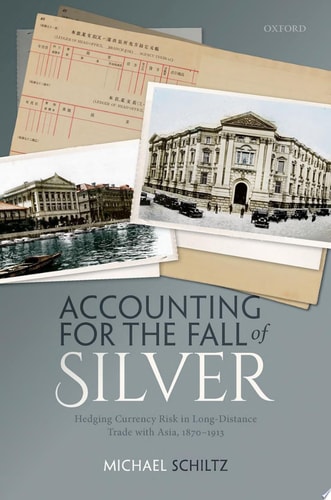
Accounting for the Fall of Silver: Hedging Currency Risk in Long-distance Trade with Asia, 1870-1913
0
0
As an Amazon Associate and affiliate partner, Menrva Books earns from qualifying purchases. Learn more
Author Description
Cover -- Accounting For The Fall Of Silver: Hedging Currency Risk In Long-distance Trade With Asia, 1870-1913 -- Copyright -- Dedication -- Preface And Acknowledgements -- Contents -- Nomenclature, Conventions, And Currency -- 1. A Note On Sources And Conventions -- 2. Currencies -- 3. The Chinese Monetary System -- List Of Figures And Tables -- Epigraph -- Chapter 1: Introduction: Liquidity, Hard And Soft Currencies, And Trade Finance -- 1. Introduction -- 2. Center And Periphery In The Literature -- 3. The Geography Of The International Monetary System, 1890-1910 4. The Peripheral Predicament -- 5. The Bell Jar Revisited -- 6. The 'international Banks' -- 7. Why This Book? -- 8. Structure Of This Book -- Appendix 1 -- Appendix 2 -- Chapter 2: Silver Risk, Silver Exports, And Sovereign Debt In The Nineteenth Century: A Brief Reappraisal -- 1. Introduction -- 2. The Long Bimetallist Swan Song: An East-west Connect -- 3. Gold, Silver, And The Periphery -- 4. 'where Ought India To Borrow?' -- 5. Chinese Borrowing In The 1890s -- Chapter 3: Trade Finance In The Late Nineteenth Century: Accounting For Silver Risk -- 1. Introduction 2. The Early Days: London As The Pivot Of All International Trade Finance -- 3. 1876 And Beyond -- 4. The Rise Of 'interest Bills' ('advance Bills') -- 5. Interest Bills And The Debate On 'real Bills' Vs. 'finance Bills': A Nineteenth-century Carry Trade -- Chapter 4: 'on An Even Keel': Hedging Exchange Rate Risk On The Branch Network Level -- 1. Introduction -- 2. From The Fall Of The Oriental Bank To Hongkong And Shanghai Banking Corporation Losses -- 3. Hedging Exchange Risk: From Unit Of Account To The 'even Keel' -- 4. Specie Points, Exchange Rates, The Even Keel, And Managerial Success 2. Ysb Semestrial Reports -- 3. Interpretative Hurdles -- 4. The Flow-of-funds Among Branches: Construction Of The Dataset -- 5. A Methodological Issue: Amounts Of Bills Sent Or Amounts Of Funds Being Transferred? -- 6. Fund-matching And Exchange Position
Menrva's Summary
THE THESIS
This work investigates how international banks managed and hedged the significant currency risks associated with the volatility of silver prices during the late nineteenth-century trade between Western powers and Asian markets. Michael Schiltz, a historian specializing in global financial history, utilizes archival records from international banking institutions to analyze the mechanisms of trade finance. He argues that the transition from silver-based to gold-based monetary systems necessitated sophisticated accounting and hedging strategies to maintain liquidity and profitability in long-distance trade.
THE SCOPE MAP
What You Will Find
- Analysis of the Chinese monetary system and its interaction with global gold standards.
- Examination of the 'even keel' hedging strategy used by branch networks of international banks.
- Historical data on interest bills, advance bills, and the mechanics of nineteenth-century carry trades.
- Case studies of major financial institutions, including the Hongkong and Shanghai Banking Corporation.
Scope Limits
- The analysis is primarily focused on the period between 1870 and 1913.
- The text does not provide a comprehensive history of all global trade, focusing specifically on the silver-gold exchange risk.
THE AUTHORITY PERSPECTIVE
Experts in economic history recognize this text as a rigorous examination of the technical challenges faced by financial institutions during the transition to the gold standard. Readers frequently note the academic density of the prose, which is intended for scholars of financial history and monetary economics.
Page Count:
0
Publication Date:
1900-01-01
Publisher:
Oxford University Press,
ISBN-10:
019263416X
ISBN-13:
9780192634160
International Trade
Money history
Economic History
Asian History
19th Century
Finance
silver
Community Tags
Similar Books