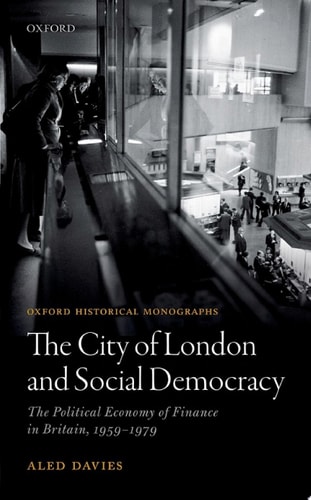
The City of London and Social Democracy: The Political Economy of Finance in Britain, 1959-1979
0
0
As an Amazon Associate and affiliate partner, Menrva Books earns from qualifying purchases. Learn more
Author Description
The City of London and Social Democracy examines the relationship between the financial sector and the state in post-war Britain. The key argument made in Aled Davies's study is that changes to the financial sector during the 1960s and 1970s undermined the state's capacity to sustain and develop a modern industrial economy. Social democratic economic strategy was constrained by the institutionalization of investment in pension and insurance funds; the fragmentation of the nation's oligopolistic domestic banking system; the emergence of an unregulated international capital market based in London; and the breakdown of the Bretton Woods international monetary system. Novel attempts to reconfigure social democratic economic strategy in response to these changes ultimately proved unsuccessful. Meanwhile, the assumption that national prosperity could only be achieved through industrial growth was challenged by a reconceptualization of Britain as a fundamentally financial and commercial nation -- an idea that was successfully promoted by the City itself. These findings assert the need to place the Thatcher governments' subsequent neoliberal economic revolution, which saw the acceleration of deindustrialization and the triumph of the City of London as a pre-eminent international financial centre, within a broader material, institutional, and cultural context previously underappreciated by historians.
Menrva's Summary
THE THESIS
This study investigates how the evolving relationship between the City of London and the British state during the 1960s and 1970s eroded the foundations of post-war social democratic economic policy. Aled Davies, a historian specializing in modern British political economy, utilizes archival research and economic analysis to argue that structural shifts in finance—specifically the rise of international capital markets and the institutionalization of pension funds—severely limited the government's ability to foster industrial growth. The work posits that these developments necessitated a fundamental shift in the national identity, moving away from an industrial focus toward a financial and commercial orientation, which ultimately paved the way for the neoliberal policies of the Thatcher era.
THE SCOPE MAP
What You Will Find
- Analysis of the collapse of the Bretton Woods monetary system and its impact on British policy.
- Examination of the institutional shift toward pension and insurance fund investment.
- Investigation into the fragmentation of the domestic banking sector.
- Historical context regarding the transition from industrialism to financialization.
Scope Limits
- The study focuses primarily on the period between 1959 and 1979.
- It does not provide a comprehensive history of the Thatcher administration, but rather analyzes the conditions that preceded it.
THE AUTHORITY PERSPECTIVE
Scholars and historians recognize this work as a rigorous contribution to the study of British political economy, noting its success in bridging the gap between financial history and political analysis. Readers frequently highlight the academic density of the prose, which is well-suited for researchers and students of twentieth-century British history.
Page Count:
260
Publication Date:
2017-01-01
Publisher:
OUP Oxford
ISBN-10:
0192526111
ISBN-13:
9780192526113
History
European History
British History
Economic History
Finance
Community Tags
Similar Books