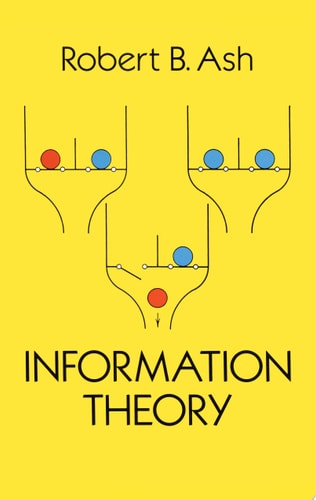
Information Theory
0
0
As an Amazon Associate and affiliate partner, Menrva Books earns from qualifying purchases. Learn more
Author Description
Developed by Claude Shannon and Norbert Wiener in the late 1940s, information theory, or statistical communication theory, deals with the theoretical underpinnings of a wide range of communication devices: radio, television, radar, computers, telegraphy, and more. This book is an excellent introduction to the mathematics underlying the theory. Designed for upper-level undergraduates and first-year graduate students, the book treats three major areas: analysis of channel models and proof of coding theorems (chapters 3, 7, and 8); study of specific coding systems (chapters 2, 4, and 5); and study of statistical properties of information sources (chapter 6). Among the topics covered are noiseless coding, the discrete memoryless channel, effort correcting codes, information sources, channels with memory, and continuous channels. The author has tried to keep the prerequisites to a minimum. However, students should have a knowledge of basic probability theory. Some measure and Hilbert space theory is helpful as well for the last two sections of chapter 8, which treat time-continuous channels. An appendix summarizes the Hilbert space background and the results from the theory of stochastic processes necessary for these sections. The appendix is not self-contained but will serve to pinpoint some of the specific equipment needed for the analysis of time-continuous channels. In addition to historic notes at the end of each chapter indicating the origin of some of the results, the author has also included 60 problems with detailed solutions, making the book especially valuable for independent study.
Menrva's Summary
THE THESIS
The book provides a rigorous mathematical introduction to the foundational principles of information theory. Developed by pioneers like Claude Shannon and Norbert Wiener, information theory underpins a vast array of modern communication technologies. This text is designed for advanced undergraduates and graduate students, focusing on the mathematical underpinnings of the field. It systematically explores channel models, coding theorems, specific coding systems, and the statistical properties of information sources.
THE SCOPE MAP
- Analysis of channel models and proof of coding theorems (chapters 3, 7, and 8)
- Study of specific coding systems (chapters 2, 4, and 5)
- Study of statistical properties of information sources (chapter 6)
- Coverage of topics including noiseless coding, the discrete memoryless channel, error-correcting codes, information sources, channels with memory, and continuous channels
- Minimization of prerequisites, though basic probability theory is expected
- Appendix summarizing Hilbert space and stochastic process theory for advanced sections
- 60 problems with detailed solutions, suitable for independent study
THE AUTHORITY PERSPECTIVE
This book is presented as an excellent introduction to the mathematics of information theory, suitable for upper-level undergraduates and first-year graduate students. The author's effort to minimize prerequisites and the inclusion of detailed solutions for problems suggest a design that supports self-study and a thorough understanding of the subject matter. The text covers core areas of channel modeling, coding, and information sources, indicating a comprehensive scope for its intended audience.
Page Count:
352
Publication Date:
2012-06-14
Publisher:
Dover Publications
ISBN-10:
0486141454
ISBN-13:
9780486141459
Science & Technology
Non-Fiction
Science
Engineering
Computer Science
Mathematics
Community Tags
Other Editions(3)

Similar Books




Reader Comments
Share Your Thoughts
No comments yet. Be the first to share your thoughts!