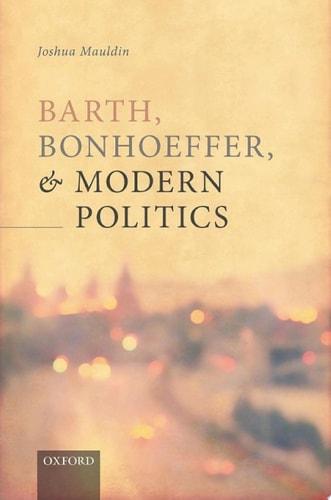
Barth, Bonhoeffer, and Modern Politics
0
0
As an Amazon Associate and affiliate partner, Menrva Books earns from qualifying purchases. Learn more
Author Description
Recent political events around the world have raised the spectre of an impending collapse of democratic institutions. Contemporary concerns about the decline of liberal democracy are reminicent to the tumult of the 1930s and 1940s in Europe. Karl Barth and Dietrich Bonhoeffer lived in Germany during the rise of National Socialism, and each reflected on what the rise of totalitarianism meant for the aspirations of modern politics. Engaging the realities of totalitarian terror, they avoided despairing rejections of modern society. Beginning with Barth in the wake of the First World War, following Bonhoeffer through the 1930s and 1940s in Nazi Germany, and concluding with Barth's post-war reflections in the 1950s, this study explores how these figures reflected on modern society during this turbulent time and how their work is relevant to the current crisis of modern democracy.
Menrva's Summary
THE THESIS
This study investigates how the theological and political reflections of Karl Barth and Dietrich Bonhoeffer during the rise of totalitarianism in Europe offer critical insights into the contemporary crisis of liberal democracy. Joshua Mauldin, a scholar of political theology, examines the historical context of the 1930s and 1940s to determine how these thinkers navigated the collapse of institutions without succumbing to nihilism. By analyzing their writings from the post-WWI era through the post-WWII period, the author constructs a framework for understanding the resilience of democratic aspirations in the face of authoritarian threats.
THE SCOPE MAP
What You Will Find
- Analysis of Barth's theological responses to the First World War and post-war reconstruction.
- Examination of Bonhoeffer's resistance and reflections during the Nazi regime.
- Comparative study of totalitarianism and its impact on modern political structures.
- Theoretical application of 20th-century theological ethics to 21st-century democratic decline.
Scope Limits
- The text does not provide a comprehensive biography of either figure, focusing instead on their political-theological output.
- The analysis does not cover non-Western political developments or non-Christian political philosophies.
THE AUTHORITY PERSPECTIVE
Scholars and readers note the academic rigor and historical precision of Mauldin's analysis. The text is frequently cited as a significant contribution to the field of political theology for those seeking to apply historical theological frameworks to current democratic instability.
Page Count:
175
Publication Date:
2021-01-01
Publisher:
OUP Oxford
ISBN-10:
0192637533
ISBN-13:
9780192637536
Philosophy
History
Religion
Political theology
20th Century
Democracy
Christian ethics
Community Tags
Other Editions(3)


Similar Books