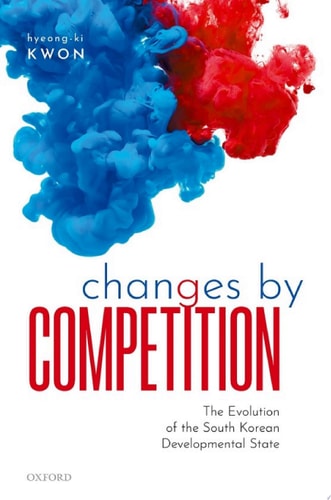
Changes by Competition: The Evolution of the South Korean Developmental State
0
0
As an Amazon Associate and affiliate partner, Menrva Books earns from qualifying purchases. Learn more
Author Description
By tracing the evolution of South Korean state-led capitalism and comparing it with other economies, this book critiques prevalent theories including neoliberalism, the developmental state, and institutionalism, and proposes a theoretical alternative focusing on endogenous changes through elites' competition within and outside the state. Unlike the arguments of neoliberals, this volume asserts that the state can still play an active role in reconstituting the national economy through globalization. The Korean state successfully fosters economic growth by nurturing industrial commons through globalization, rather than by adopting a neoliberal free-market system. This volume exerts that the Korean economy has successfully grown over the past 50 years because it has moved toward a new version of state-led developmentalism. In order to better account for the evolution of state-led developmentalism, this book proposes changes by competition within, as well as outside, the state, in order to bring about changes in developmentalism and the ability to adjust to new contexts. Unlike prevalent accounts of developmental state theory, Changes by Competition argues that the state is neither unitary nor cohesive, but a locus of competition.
Menrva's Summary
THE THESIS
This book investigates how the South Korean state has evolved its economic model through internal and external elite competition rather than through neoliberal market adoption. Hyeong-ki Kwon, an expert in political economy, challenges traditional developmental state theories by arguing that the state is not a monolithic entity but a dynamic site of conflict. He posits that South Korea's sustained growth is the result of a reconstituted state-led developmentalism that actively manages globalization to nurture industrial commons.
THE SCOPE MAP
What You Will Find
- A comparative analysis of South Korean state-led capitalism against other global economic models.
- A theoretical framework centered on elite competition as the primary driver of institutional change.
- An examination of the state's role in industrial policy over the past 50 years.
Scope Limits
- The analysis focuses primarily on the South Korean experience and may not fully account for smaller or less industrialized economies.
- The text does not provide a comprehensive history of Korean social movements outside of elite political and economic spheres.
THE AUTHORITY PERSPECTIVE
Scholars in the field of East Asian political economy recognize this work as a significant critique of standard neoliberal interpretations of the developmental state. Readers frequently note the academic density of the prose, which is intended for researchers and students of comparative political economy.
Page Count:
228
Publication Date:
2021-01-01
Publisher:
OUP Oxford
ISBN-10:
0192635611
ISBN-13:
9780192635617
History
Economics
Globalization
Developmental State Theory
Korean History
Economic History
Asian History
Community Tags
Similar Books