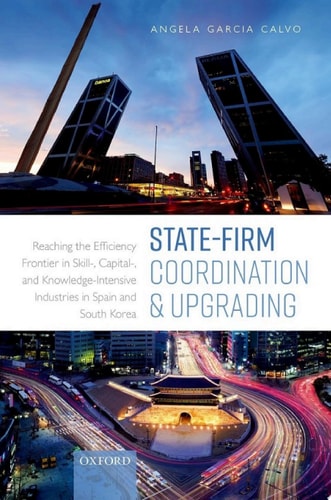
State-Firm Coordination and Upgrading: Reaching the Efficiency Frontier in Skill-, Capital-, and Knowledge-Intensive Industries in Spain and South Korea
0
0
As an Amazon Associate and affiliate partner, Menrva Books earns from qualifying purchases. Learn more
Author Description
Since the 1980s, Spain and South Korea have experienced a dramatic transformation from middle-income to advanced economies. While market liberalization and globalization were important forces for change, and while states continue to be central in the organization of the Spanish and South Korean economies, the liberal and the developmental state perspectives do not provide an understanding of critical elements of these transformations. Building on a combination of historical institutionalism and international business literature, this book shows that upgrading was underpinned by cooperative models based on interdependencies and quid pro quo exchanges between national governments and large firms. The negotiated nature of these arrangements opened the door to institutional variation and enabled Spain and South Korea to pursue different strategies. Spain pursued an integrational approach based on foreign direct investment, technological outsourcing, and regional integration. South Korea pursued a techno-industrial strategy that prioritized self-sufficiency and the development of local technological capacity. Both strategies enabled Spanish and South Korean firms across multiple complex sectors to reach the efficiency frontier, but resulted in different productive specializations in complex services and manufacturing respectively. Through a comparative study this book shifts our perspective on the political economy of economic transformation: from markets or states, to state-firm coordination, as a driver for economic transformation; from one, to at least two, different pathways to upgrading; and from a world divided into emerging economies and world leaders, to a more nuanced perspective that recognizes the perspective of new advanced economies.
Menrva's Summary
THE THESIS
This book investigates how state-firm coordination serves as a primary driver for economic transformation in middle-income countries seeking to reach the efficiency frontier in advanced industries. Angela Garcia Calvo, a scholar of political economy, utilizes a framework rooted in historical institutionalism and international business theory to analyze the economic trajectories of Spain and South Korea. She argues that neither pure market liberalization nor traditional developmental state models fully explain the successful transition of these nations, proposing instead that cooperative, negotiated arrangements between governments and large firms were the critical mechanisms for industrial upgrading.
THE SCOPE MAP
What You Will Find
- Comparative analysis of economic development strategies in Spain and South Korea since the 1980s.
- Examination of state-firm coordination models including foreign direct investment, technological outsourcing, and local capacity building.
- Analysis of how institutional variation leads to different pathways for reaching the efficiency frontier in complex sectors.
Scope Limits
- The study focuses specifically on the period from the 1980s to the present.
- The analysis is limited to the comparative experiences of Spain and South Korea rather than a global survey of all emerging economies.
THE AUTHORITY PERSPECTIVE
Scholars in the field of comparative political economy recognize this work as a significant contribution to understanding the nuances of state-led economic development. The text is noted for its rigorous academic approach and its ability to bridge the gap between institutional theory and international business practice.
Page Count:
842
Publication Date:
2021-01-01
Publisher:
OUP Oxford
ISBN-10:
019263349X
ISBN-13:
9780192633491
South Korea
Spain
International business
Comparative Politics
Community Tags
Similar Books