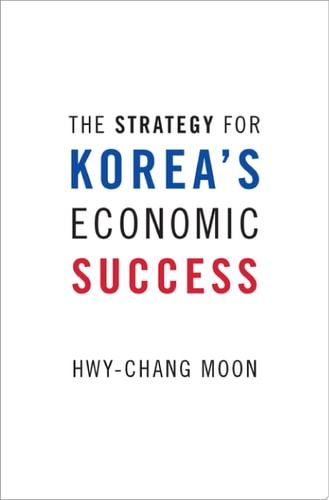
The Strategy for Korea's Economic Success
0
0
As an Amazon Associate and affiliate partner, Menrva Books earns from qualifying purchases. Learn more
Author Description
Korea's economic success has inspired numerous studies and research projects in past decades. Despite good efforts to analyze the strategy of Korea, earlier studies have not been able to comprehensively and systematically explain the country's "miraculous" growth. After thorough analysis of these earlier studies, a new model has been developed by showing that a country or firm does not have to be more innovative or possess more resources to have a competitive advantage over others. In The Strategy for Korea's Economic Success, Hwy-Chang Moon details four factors that comprise the ABCD model and illustrates how the Korean government, corporations, and people have exemplified these factors in achieving their current level of success. The four factors are agility (speed + precision), benchmarking (learning + best practices), convergence (mixing + synergy), and dedication (diligence + goal-orientation). Together, these factors have enabled Korea's economic success and will continue to drive the next level of growth. Anyone can become more competitive with proper implementation of the ABCDs. Korea's development strategy holds special value, because it is more practical and appropriate for many developing countries. For more developed countries, on the other hand, the ABCDs can be used to fast-track the next phase of growth. Moon also highlights the role of internationalization in broadening the scope of strategic choices, and shows how the combined implementation of internationalization and the ABCDs deepens the pool of strategic resources.
Menrva's Summary
THE THESIS
This book investigates the core factors behind South Korea's rapid economic development to provide a systematic framework for competitive advantage. Hwy-Chang Moon, a professor of international business and strategy, synthesizes historical economic data and management theory to propose the ABCD model. He argues that competitive success does not rely solely on innovation or resource abundance, but on the strategic application of specific behavioral and operational principles.
THE SCOPE MAP
What You Will Find
- The ABCD model: Agility, Benchmarking, Convergence, and Dedication
- Analysis of the interplay between government policy, corporate strategy, and national work ethic
- Strategies for internationalization as a tool for resource expansion
Scope Limits
- Does not provide a comprehensive political history of the Korean peninsula
- Does not focus on micro-level financial accounting or specific stock market analysis
THE AUTHORITY PERSPECTIVE
Experts recognize this work as a practical framework for understanding the developmental trajectory of emerging economies. Readers frequently note the accessibility of the ABCD model for both academic study and corporate strategic planning.
Page Count:
301
Publication Date:
2016-01-01
Publisher:
Oxford University Press
ISBN-10:
0190228814
ISBN-13:
9780190228811
Business
Economics
International business
South Korea
Developing Countries
Strategy