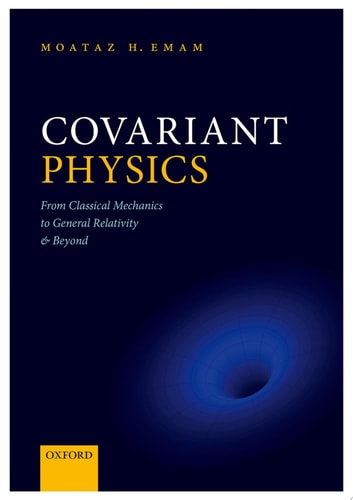
Covariant Physics: From Classical Mechanics to General Relativity and Beyond
0
0
As an Amazon Associate and affiliate partner, Menrva Books earns from qualifying purchases. Learn more
Author Description
Covariant Physics: From Classical Mechanics to General Relativity and Beyond endeavours to provide undergraduate students as well as self-learners with training in the fundamentals of the modern theories of spacetime, most notably the general theory of relativity as well as physics in curved spacetime backgrounds in general. This text does so with the barest of mathematical preparation. In fact, very little beyond multivariable calculus and a bit of linear algebra is assumed. Throughout this textbook, the main theme tying the various topics is the so-called principle of covariance - a fundamental symmetry of physics that one rarely encounters in undergraduate texts. The material is introduced very gradually, starting with the simplest of high school mathematics, and moving through the more intense notions of tensor calculus, geometry, and differential forms with ease. Familiar notions from classical mechanics and electrodynamics are used to increase familiarity with the advanced mathematical ideas, and to emphasize the unity of all of physics under the single principle of covariance. The mathematical and physical techniques developed in this book should allow students to perform research in various fields of theoretical physics as early as their sophomore year in college. The language the reader will learn in this book is the foundational mathematical language of many modern branches of physics, and as such should allow them to read and generally understand many modern physics papers.
Menrva's Summary
THE THESIS
This text investigates the principle of covariance as a unifying framework for modern physics, bridging the gap between classical mechanics and general relativity for undergraduate students. Author Moataz H. Emam utilizes his background in theoretical physics to construct a pedagogical path that introduces complex geometric and algebraic concepts with minimal mathematical prerequisites. By anchoring advanced topics in familiar classical mechanics and electrodynamics, the book argues that the principle of covariance provides a cohesive language for understanding spacetime and modern theoretical research.
THE SCOPE MAP
What You Will Find
- Introduction to tensor calculus, differential geometry, and differential forms
- Application of covariance to classical mechanics and electrodynamics
- Step-by-step derivation of physics in curved spacetime backgrounds
Scope Limits
- Does not require advanced graduate-level mathematical preparation
- Focuses primarily on the principle of covariance rather than exhaustive historical context
THE AUTHORITY PERSPECTIVE
Readers frequently note the accessibility of the prose, which successfully lowers the barrier to entry for complex theoretical topics. Experts highlight this as a practical resource for undergraduates seeking to gain proficiency in the mathematical language of modern physics early in their academic careers.
Page Count:
416
Publication Date:
2021-01-01
Publisher:
OUP Oxford
ISBN-10:
0192634003
ISBN-13:
9780192634009
Classical Mechanics
Physics
Theoretical Physics
Modern Physics
textbook
General Relativity
Mathematics
Earth Sciences
Community Tags
Similar Books