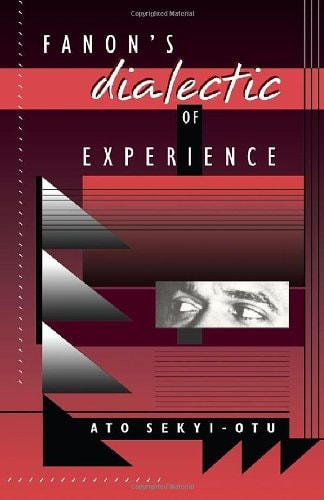
Fanon's Dialectic of Experience
0
0
As an Amazon Associate and affiliate partner, Menrva Books earns from qualifying purchases. Learn more
Author Description
With the flowering of postcolonialism, we return to Frantz Fanon, a leading theorist of the struggle against colonialism. In this thorough reinterpretation of Fanon's texts, Ato Sekyi-Otu ensures that we return to him fully aware of the unsuspected formal complexity and substantive richness of his work. A Caribbean psychiatrist trained in France after World War II and an eloquent observer of the effects of French colonialism on its subjects from Algeria to Indochina, Fanon was a controversial figure--advocating national liberation and resistance to colonial power in his bestsellers, Black Skin, White Masks and The Wretched of the Earth. But the controversies attending his life--and death, which some ascribed to the CIA--are small in comparison to those surrounding his work. Where admirers and detractors alike have seen his ideas as an incoherent mixture of Existentialism, Marxism, and psychoanalysis, Sekyi-Otu restores order to Fanon's oeuvre by reading it as one dramatic dialectical narrative.Fanon's Dialectic of Experience invites us to see Fanon as a dramatist enacting a movement of experience--the drama of social agents in the colonial context and its aftermath--in a manner idiosyncratically patterned on the narrative structure of Hegel's Phenomenology of Spirit. By recognizing the centrality of experience to Fanon's work, Sekyi-Otu allows us to comprehend this much misunderstood figure within the tradition of political philosophy from Aristotle to Arendt.
Menrva's Summary
THE THESIS
This book reinterprets Frantz Fanon's work as a unified dialectical narrative, challenging common perceptions of his thought as an incoherent mixture of various philosophies. Ato Sekyi-Otu, drawing on Fanon's background as a Caribbean psychiatrist and his experiences with colonialism, argues that Fanon's texts follow a structure akin to Hegel's Phenomenology of Spirit. The book aims to reveal the formal complexity and substantive richness of Fanon's writings, positioning him within the tradition of political philosophy from Aristotle to Arendt by emphasizing the centrality of lived experience in his theories.
THE SCOPE MAP
- A thorough reinterpretation of Frantz Fanon's key texts, including 'Black Skin, White Masks' and 'The Wretched of the Earth'.
- Analysis of Fanon's work through the lens of Hegelian dialectics, specifically the narrative structure of 'Phenomenology of Spirit'.
- Exploration of Fanon's role as a theorist of anti-colonial struggle and liberation.
- Examination of Fanon's background as a psychiatrist and his observations on the psychological effects of colonialism.
- Contextualization of Fanon within the broader tradition of political philosophy, linking him to thinkers like Aristotle and Hannah Arendt.
- Emphasis on the concept of 'experience' as a central organizing principle in Fanon's oeuvre.
- Discussion of the controversies surrounding Fanon's ideas and their perceived synthesis of Existentialism, Marxism, and psychoanalysis.
THE AUTHORITY PERSPECTIVE
This book is regarded as a significant scholarly contribution that brings new order to the complex thought of Frantz Fanon. By framing Fanon's work as a dialectical narrative, Sekyi-Otu offers a compelling reinterpretation that highlights its formal sophistication and philosophical depth. The analysis effectively situates Fanon within major currents of political thought, making his challenging ideas more accessible to scholars and students of postcolonialism and political philosophy. The work is noted for its meticulous scholarship and its ability to illuminate previously unappreciated aspects of Fanon's legacy.
Page Count:
288
Publication Date:
1997-01-01
Publisher:
Harvard University Press
ISBN-10:
0674294394
ISBN-13:
9780674294394
History
Non-Fiction
Philosophy
Psychiatry
Literary Criticism
Social Theory
Political Philosophy
Community Tags
Similar Books