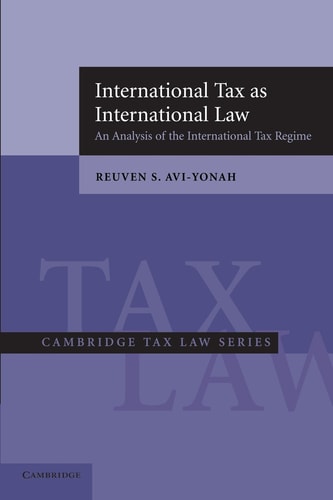
International Tax as International Law: An Analysis of the International Tax Regime
0
0
As an Amazon Associate and affiliate partner, Menrva Books earns from qualifying purchases. Learn more
Author Description
This book explains how the tax rules of the various countries in the world interact with one another to form an international tax regime: a set of principles embodied in both domestic legislation and treaties that significantly limits the ability of countries to choose any tax rules they please. The growth of this international tax regime is an important part of the phenomenon of globalization, and the book delves into how tax revenues are divided among different countries. It also explains how U.S. tax rules in particular apply to cross-border transactions and how they embody the norms of the international tax regime.
Menrva's Summary
THE THESIS
This book investigates the emergence and structure of the international tax regime, a complex system of rules that constrains national sovereignty in taxation. It examines how domestic legislation and international treaties coalesce to form a framework that dictates how tax revenues are allocated globally, a critical component of worldwide economic integration. The author, a noted tax law scholar, analyzes the principles underlying this regime and specifically details how U.S. tax laws interact with cross-border transactions, reflecting and reinforcing international norms.
THE SCOPE MAP
- Analysis of the interaction between domestic tax legislation and international treaties.
- Explanation of the principles forming the international tax regime.
- Discussion of the impact of globalization on international taxation.
- Examination of how tax revenues are divided among nations.
- Specific focus on U.S. tax rules and their application to cross-border transactions.
- Exploration of the norms embedded within the international tax system.
THE AUTHORITY PERSPECTIVE
The book is recognized for its scholarly approach to understanding the international tax regime as a form of international law. It is appreciated for its detailed analysis of how global economic forces shape national tax policies and revenue distribution. The work is considered a significant contribution to the study of globalization and its legal underpinnings, particularly concerning fiscal matters. Its examination of U.S. tax law in the context of international transactions provides specific insights for practitioners and academics.
Page Count:
224
Publication Date:
2007-09-10
Publisher:
Cambridge University Press
ISBN-10:
0521618010
ISBN-13:
9780521618014
Non-Fiction
Politics
Economics
International Law
Taxation
Legal Studies
Globalization
Community Tags
Other Editions(2)

Similar Books