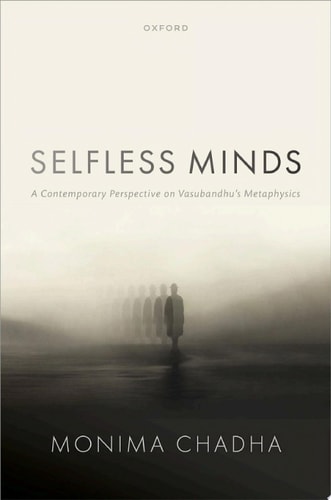
Selfless Minds: A Contemporary Perspective on Vasubandhu's Metaphysics
0
0
As an Amazon Associate and affiliate partner, Menrva Books earns from qualifying purchases. Learn more
Author Description
Selfless Minds offers a new interpretation of no-self metaphysics in Vasubandhu's Abhidharmakosa-Bhasya. Monima Chadha reads Vasubandhu as defending not only eliminativism about self but also about persons, and illusionism about the sense of self and all kinds of self-representation. This radical no-self thesis presents several challenges for Abhidharma Buddhist philosophy of mind. Even if we then grant that there is no self, we are left with deeper questions about the sense of self or self-representations implicated in our ordinary everyday experience and thought about the world and ourselves. And if we grant that there are no persons, questions remain about the status of our person-related concerns and interpersonal practices. Selfless Minds answers these questions on behalf of the Abhidharma Buddhist. The first part of the book defends the hypothesis that we can salvage much of our experience and thought without implicating self-representations. The second part of the book examines the revisionary implications of the no-person metaphysics. Some of these seem unpalatable, if not downright absurd. This, she argues, give us reason to re-evaluate both the Abhidharma metaphysics and our ordinary person-related practices and concerns in light of each other by using some sort of wide reflective equilibrium. Selfless Minds is a contribution to cross-cultural philosophy that studies the nature of selfless minds from a place at the crossroads of different traditions and disciplines: philosophy in the traditional Buddhist and contemporary Western traditions, and contemporary cognitive sciences.
Menrva's Summary
THE THESIS
This book investigates the viability of Vasubandhu’s radical no-self and no-person metaphysics within the context of contemporary philosophy of mind and cognitive science. Monima Chadha, a scholar specializing in Buddhist philosophy and epistemology, utilizes the Abhidharmakosa-Bhasya to construct a rigorous defense of eliminativism regarding the self. She argues that by adopting a framework of wide reflective equilibrium, one can reconcile Buddhist metaphysical claims with the practical realities of human experience and interpersonal concerns.
THE SCOPE MAP
What You Will Find
- An analysis of Vasubandhu’s Abhidharmakosa-Bhasya regarding self-representation and illusionism.
- A philosophical framework for navigating the absence of persons in everyday social practices.
- Integration of classical Buddhist thought with contemporary Western cognitive science models.
Scope Limits
- The text does not provide a comprehensive historical survey of all Buddhist schools of thought.
- It does not offer a practical meditation manual or religious guide, focusing strictly on metaphysical and analytical arguments.
THE AUTHORITY PERSPECTIVE
Scholars in the field of comparative philosophy recognize this work as a significant contribution to the intersection of Buddhist studies and analytic philosophy of mind. Readers frequently note the academic density of the prose, which requires a foundational understanding of both Abhidharma terminology and contemporary metaphysical discourse.
Page Count:
336
Publication Date:
2023-01-01
Publisher:
OUP Oxford
ISBN-10:
0192657941
ISBN-13:
9780192657947
Philosophy
Metaphysics
Comparative Philosophy
Buddhism
Philosophy of
Community Tags
Similar Books