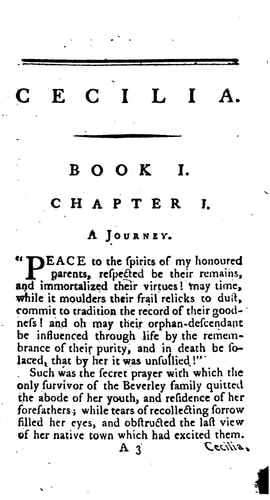
Cecilia: Or Memoirs of an Heiress
0
0
As an Amazon Associate and affiliate partner, Menrva Books earns from qualifying purchases. Learn more
Author Description
Cecilia is an heiress, but she can only keep her fortune if her husband will consent to take her surname. Fanny Burney's unusual love story and deft social satire was much admired on its first publication in 1782 for its subtle interweaving of comedy, humanity, and social analysis. Controversial in its time, this eighteenth-century novel seems entirely fresh in relation to late twentieth-century concerns. ABOUT THE SERIES: For over 100 years Oxford World's Classics has made available the widest range of literature from around the globe. Each affordable volume reflects Oxford's commitment to scholarship, providing the most accurate text plus a wealth of other valuable features, including expert introductions by leading authorities, helpful notes to clarify the text, up-to-date bibliographies for further study, and much more.
Menrva's Summary
THE PULSE
Cecilia Beverley must navigate a restrictive inheritance clause that threatens her autonomy and her choice of a marriage partner. As a wealthy heiress, Cecilia enters London society with high expectations, only to find her fortune tied to a condition requiring her future husband to adopt her surname. She faces opposition from rigid social hierarchies, predatory suitors, and the complex expectations of her guardians. The narrative utilizes a third-person perspective to examine the tension between individual desire and the rigid social structures of the late eighteenth century.
INSIDE THE PAGES
- Exploration of the legal and social limitations placed on women regarding property and marriage.
- Satirical depiction of the manners and affectations of the London upper class.
- Use of a complex, multi-layered plot involving numerous secondary characters.
- Examination of the conflict between personal integrity and social reputation.
- Detailed character studies focusing on moral development and social navigation.
- Integration of comedic elements within a serious social critique.
- Focus on the psychological pressures of wealth and status.
- Stylistic emphasis on dialogue and social interaction as a means of character revelation.
THE COLLECTIVE ECHO
Readers and critics frequently note the novel's sharp social commentary and its effectiveness in portraying the constraints of the eighteenth-century marriage market. Discussion often centers on the protagonist's moral dilemmas and the intricate web of social obligations that dictate her choices. Many highlight the balance between the comedic observations of high society and the underlying gravity of Cecilia's situation. The work is recognized for its influence on later writers, particularly Jane Austen, who drew inspiration from Burney's approach to social realism. Readers appreciate the depth of the characterizations, which provide a nuanced look at the period's social dynamics.
Page Count:
1056
Publication Date:
2008-01-01
Publisher:
OUP Oxford
ISBN-10:
0192669567
ISBN-13:
9780192669568
Romance
Classic Literature
Historical
Social Satire
English & College Success
18th century
English
Community Tags
Similar Books