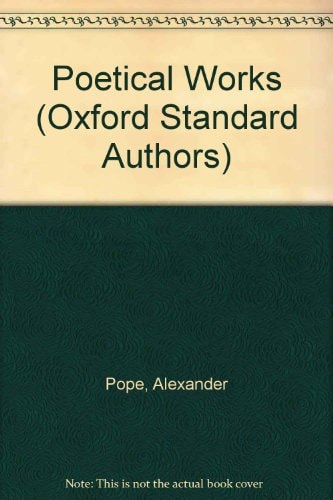
Poetical Works
0
0
As an Amazon Associate and affiliate partner, Menrva Books earns from qualifying purchases. Learn more
Author Description
This work has been selected by scholars as being culturally important, and is part of the knowledge base of civilization as we know it.This work is in the "public domain in the United States of America, and possibly other nations. Within the United States, you may freely copy and distribute this work, as no entity (individual or corporate) has a copyright on the body of the work.Scholars believe, and we concur, that this work is important enough to be preserved, reproduced, and made generally available to the public. We appreciate your support of the preservation process, and thank you for being an important part of keeping this knowledge alive and relevant.
Menrva's Summary
THE PULSE
Alexander Pope’s collected works represent the pinnacle of 18th-century neoclassical verse, exploring the tension between human reason and the chaotic nature of social existence. Through a variety of forms—including the heroic couplet, mock-epic, and didactic epistle—Pope examines the moral, political, and aesthetic landscape of his era. His writing functions as a rigorous intellectual exercise, utilizing wit and irony to critique the vanity and folly of his contemporaries. The narrative framework shifts between personal reflection, social commentary, and philosophical inquiry, maintaining a consistent focus on the order of the universe and the place of the individual within it.
INSIDE THE PAGES
- Mastery of the closed heroic couplet
- Extensive use of classical allusion and mythological reference
- Sharp, biting satirical character sketches
- Philosophical exploration of the Great Chain of Being
- Precise, balanced syntax and rhythmic control
- Mock-heroic elevation of trivial domestic conflicts
- Didactic tone regarding ethics and human nature
- Intellectual engagement with contemporary political figures
THE COLLECTIVE ECHO
Discussion often centers on Pope’s technical precision and his ability to elevate mundane subjects through the use of elevated, classical language. Readers frequently highlight the accessibility of his wit, even when the specific historical references require additional context for modern audiences. Critics often debate the balance between his rigid formal structures and the underlying emotional intensity found in his more personal epistles. The work remains a primary reference point for those studying the development of English satire and the intellectual climate of the Enlightenment. Scholars continue to analyze how his verse reflects the shifting social hierarchies and moral anxieties of the 18th century.
Page Count:
754
Publication Date:
1966-09-01
Publisher:
Oxford University Press
ISBN-10:
0192541552
ISBN-13:
9780192541550
Philosophy
Poetry
Satire
Classic Literature
18th century
Community Tags
Other Editions(3)
Similar Books