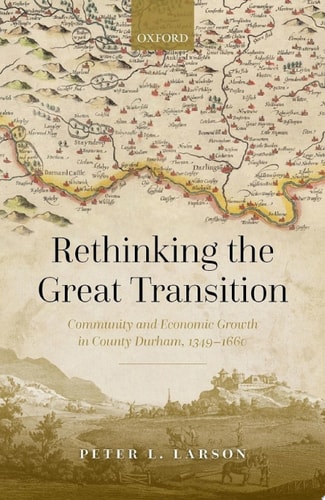
Rethinking the Great Transition: Community and Economic Growth in County Durham, 1349-1660
0
0
As an Amazon Associate and affiliate partner, Menrva Books earns from qualifying purchases. Learn more
Author Description
This case study of two rural parishes in County Durham, England, provides an alternate view on the economic development involved in the transition from medieval to modern, partly explaining England's rise to global economic dominance in the seventeenth century. Coal mining did not come to these parishes until the nineteenth century; these are an example of agrarian expansion. Low population, favourable seigniorial administration, and a commercialised society saw the emergence of large farms on the bishopric of Durham soon after the Black Death; these secure copyhold and leasehold tenures were among the earliest known in England. Individualism developed within a strong parish and village community that encouraged growth while enforcing conformity: tenants had freedom to farm as they wished, within limits. Along with low rents, this allowed for a swift expansion of agricultural production in the sixteenth century as population rose and then as the coal trade expanded rapidly. The prosperity of these men is reflected in their lands, livestock, and consumer goods. Yet not all shared in this prosperity, as the poor and landless increased in number simply by population growth. Through reformation and rebellion, these and other parishes prospered without experiencing severe disruption or destruction. In north-eastern England, agrarian development was an evolution and not a revolution. This study shows England's economic development as a single narrative, woven together from a collection of regional experiences at different times and at different speeds.
Menrva's Summary
THE THESIS
This study investigates how agrarian expansion in County Durham parishes between 1349 and 1660 contributed to England's transition from a medieval to a modern economy. Peter L. Larson utilizes archival records from two specific rural parishes to challenge the notion that England's economic rise was solely driven by industrialization or sudden revolution. By examining land tenure, population dynamics, and local governance, the author argues that regional agrarian development provided a foundational framework for broader national prosperity.
THE SCOPE MAP
What You Will Find
- Analysis of copyhold and leasehold tenure systems in the bishopric of Durham.
- Examination of the relationship between individualistic farming practices and communal village conformity.
- Data on agricultural production, livestock, and consumer goods ownership across the sixteenth and seventeenth centuries.
Scope Limits
- The study does not cover the nineteenth-century industrialization or the later rise of large-scale coal mining in these specific parishes.
- The research is geographically restricted to two rural parishes in County Durham rather than providing a comprehensive national survey.
THE AUTHORITY PERSPECTIVE
Historians and scholars of early modern England recognize this work as a significant contribution to regional economic history. Experts frequently highlight the book's ability to synthesize local archival findings into a broader narrative regarding England's economic evolution.
Page Count:
239
Publication Date:
2022-01-01
Publisher:
OUP Oxford
ISBN-10:
0192666819
ISBN-13:
9780192666819
History
European History
Social History
Europe
British History
Economic History
Community Tags
Similar Books