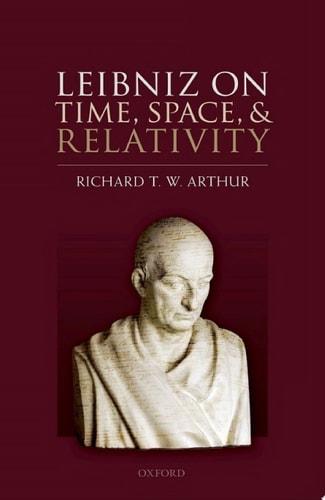
Leibniz on Time, Space, and Relativity
0
0
As an Amazon Associate and affiliate partner, Menrva Books earns from qualifying purchases. Learn more
Author Description
In this book, Arthur gives fresh interpretations of Gottfried Leibniz's theories of time, space, and the relativity of motion, based on a thorough examination of Leibniz's manuscripts as well as his published papers. These are analysed in historical context, but also with an eye to their contemporary relevance. Leibniz's views on relativity have been extremely influential, first on Mach, and then on Einstein, while his novel approach to geometry in his analysis situs inspired many later developments in geometry. Arthur expounds the latter in some detail, explaining its relationship to Leibniz's metaphysics of space and the grounding of motion, and defending Leibniz's views on the relativity of motion against charges of inconsistency. The brilliance of his work on time, though, has not been so well appreciated, and Arthur attempts to remedy this through a detailed discussion of Leibniz's relational theory of time, showing how it underpins his theory of possible worlds, his complex account of contingency, and his highly original treatment of the continuity of time, providing formal treatments in an appendix. In other appendices, Arthur provides translations of previously untranslated writings by Leibniz on analysis situs and on Copernicanism, as well as an essay on Leibniz's philosophy of relations. In his introductory chapter he explains how the framework for the book is provided by the interpretation of Leibniz's metaphysics he defended in his earlier Monads, Composition, and Force (OUP 2018, winner of the 2019 annual JHP Book Prize for best book in the history of philosophy published in 2018).
Menrva's Summary
THE THESIS
This book investigates the coherence and contemporary relevance of Gottfried Leibniz's theories regarding time, space, and the relativity of motion. Richard T. W. Arthur, a scholar of early modern philosophy, utilizes a rigorous examination of both published papers and private manuscripts to reconstruct Leibniz's metaphysical framework. By situating these theories within their historical context, the author argues for the internal consistency of Leibniz's relational view of time and motion, while highlighting its influence on subsequent scientific developments from Mach to Einstein.
THE SCOPE MAP
What You Will Find
- A detailed analysis of Leibniz's relational theory of time and its connection to his theory of possible worlds.
- An exploration of Leibniz's analysis situs and its impact on the development of modern geometry.
- Translations of previously unavailable primary source writings on Copernicanism and the philosophy of relations.
- Formal mathematical and logical treatments of Leibniz's continuity of time provided in appendices.
Scope Limits
- The text assumes a foundational understanding of Leibnizian metaphysics as established in the author's previous work, Monads, Composition, and Force.
- The analysis focuses primarily on the philosophical and geometric implications rather than a broad survey of 17th-century physics.
THE AUTHORITY PERSPECTIVE
Scholars and historians of philosophy recognize this work as a rigorous contribution to the study of Leibnizian mechanics and metaphysics. Readers frequently note the academic density of the prose, which is intended for those already familiar with the technical nuances of early modern philosophy.
Page Count:
420
Publication Date:
2021-01-01
Publisher:
OUP Oxford
ISBN-10:
019266560X
ISBN-13:
9780192665607
Philosophy
Metaphysics
Physics
Philosophy history
Science History
Community Tags
Similar Books