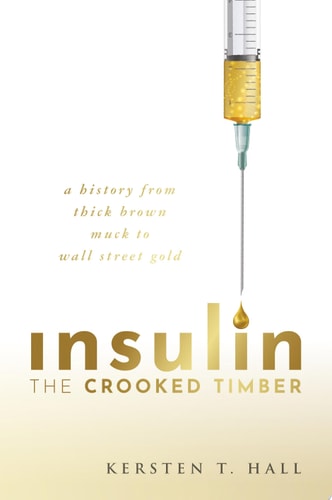
Insulin: The Crooked Timber - A History from Thick Brown Muck to Wall Street Gold
0
0
As an Amazon Associate and affiliate partner, Menrva Books earns from qualifying purchases. Learn more
Author Description
Before the discovery of insulin, a diagnosis of Type 1 diabetes was a death sentence. One hundred years after a milestone medical discovery, 'Insulin - The Crooked Timber' tells the story of how insulin was transformed from what one clinician called 'thick brown muck' into the very first drug to be produced using genetic engineering, one which would earn the founders of the US biotech company Genentech a small fortune. Yet when Canadian doctor Frederick Banting was told in 1923 that he had won the Nobel Prize for this life-saving discovery, he was furious. For the prize had not been awarded to him alone - but jointly with a man whom he felt had no right to this honour. The human story behind this discovery is one of ongoing political and scientific controversy. Taking the reader on a fascinating journey, starting with the discovery of insulin in the 1920s through to the present day, 'Insulin - The Crooked Timber' reveals a story of monstrous egos, toxic career rivalries, and a few unsung heroes such as two little known scientists whose work on wool fibres, carried out in a fume-filled former stable, not only proved to be crucial in unravelling the puzzle of insulin but ushered in a revolution in biology. It was the author's own shocking diagnosis with Type 1 diabetes that prompted him to sit down and write this book, but this story has lessons for us all about what technology can - and more importantly cannot - do for us. As the world pins its hopes on effective and lasting vaccines against Covid-19, these lessons from the story of insulin have never been more relevant.
Menrva's Summary
THE THESIS
This book investigates the complex historical, political, and scientific evolution of insulin from its early 20th-century discovery to its modern status as a cornerstone of the biotech industry. Kersten T. Hall, drawing on his personal experience as a patient with Type 1 diabetes, examines the human dynamics behind the medical breakthrough. He utilizes historical records and scientific archives to argue that the development of insulin was driven as much by ego and institutional rivalry as by clinical necessity, ultimately shaping the trajectory of genetic engineering.
THE SCOPE MAP
What You Will Find
- Historical account of the 1920s discovery of insulin
- Analysis of the transition from animal-derived extracts to genetically engineered pharmaceuticals
- Examination of the professional conflicts between Frederick Banting and his contemporaries
- Case studies of overlooked contributors in early protein research
Scope Limits
- Does not provide clinical medical advice for current diabetes management
- Does not offer a comprehensive technical manual on modern insulin production methods
THE AUTHORITY PERSPECTIVE
Experts and readers frequently note the book's success in balancing rigorous historical research with a compelling narrative about the human cost of scientific progress. It is widely regarded as a significant contribution to the history of medicine, particularly for its focus on the intersection of corporate interests and laboratory discovery.
Page Count:
288
Publication Date:
2021-01-01
Publisher:
OUP Oxford
ISBN-10:
0192667823
ISBN-13:
9780192667823
Biography
Science
History
Diabetes
Physiology
Biotechnology
Medicine
Earth Sciences
Community Tags
Similar Books