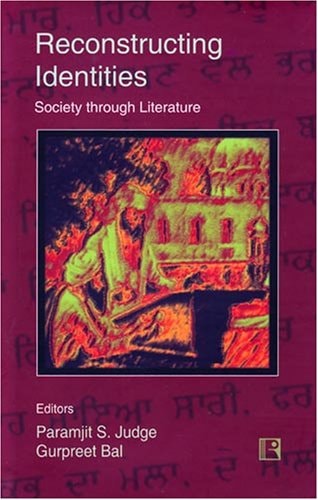
Reconstructing Identities: Society through Literature
0
0
As an Amazon Associate and affiliate partner, Menrva Books earns from qualifying purchases. Learn more
Author Description
This book's central focus is the use of literary texts to reconstruct identities in the region of Punjab. This collective effort examines the evolution of the Punjabi society in terms of religion, gender, caste, class, and rivalry. Starting with 18th century texts, the volume explores various facets of the social life of Punjab through the end of colonial period. It becomes clear that there was a definite change in the way religion and gender in particular were constructed across a time span of three centuries. In the case of religion, there has been a movement from composite religious practices to the construction of singular religious tradition, which was done in a way that culminated into communal riots, killing, and displacing of millions of Punjabis. The construction of gender presents the most interesting dimension of the Punjabi society. The struggle of woman against patriarchy becomes visible even in the 18th century. In the 19th century, the first Punjabi woman poet, Peero, raises the voice against suppression and marginality of woman in the Punjabi society. An endeavor towards the construction of gender identity in the 19th century became simultaneously an act of creating religious boundaries, as was evident in the writings of Bhai Vir Singh. The contributions in this book show how these identities form crucial elements in the dynamism of society. The historical and sociological evidence corroborates the interpretation of select literary texts to understand Punjabi society. Seen historically, the interpretative analyses of the texts show tremendous continuity in the forging, reinterpretation, and reconstruction of identities.
Menrva's Summary
THE THESIS
This book investigates how literary texts from Punjab have been instrumental in reconstructing individual and societal identities. The authors, Gurpreet Bal and Paramjit S. Judge, utilize a collective approach to examine the evolution of Punjabi society across religion, gender, caste, class, and rivalry, beginning with 18th-century texts and extending through the colonial period. The analysis reveals significant shifts in the construction of religion and gender over three centuries, noting a progression from composite religious practices to singular traditions that ultimately contributed to communal violence. The exploration of gender identity highlights women's struggles against patriarchy and the emergence of voices like the poet Peero challenging suppression, demonstrating how identity formation is intricately linked with societal dynamics.
THE SCOPE MAP
- Analysis of literary texts from 18th century Punjab to the end of the colonial period.
- Examination of the evolution of Punjabi society through lenses of religion, gender, caste, and class.
- Tracing the shift from composite religious practices to singular religious traditions and its consequences.
- Exploration of the construction of gender identity and women's resistance to patriarchy.
- Highlighting the contributions of figures like the poet Peero and Bhai Vir Singh.
- Corroboration of literary interpretations with historical and sociological evidence.
- Demonstration of continuity in the forging, reinterpretation, and reconstruction of identities over time.
THE AUTHORITY PERSPECTIVE
The book is presented as a scholarly examination of identity formation in Punjab through its literature. The authors' approach, integrating literary analysis with historical and sociological evidence, suggests a rigorous and interdisciplinary study. The focus on the evolution of religion and gender over three centuries indicates a deep dive into societal transformations and their cultural manifestations. The reception is likely that of an academic text, valued for its detailed analysis of a specific region's cultural and social history through its literary output.
Page Count:
224
Publication Date:
2008-02-25
Publisher:
Rawat Publications
ISBN-10:
8131601854
ISBN-13:
9788131601853
Literary Fiction
History
Non-Fiction
Literary Criticism
Sociology
Community Tags
Similar Books