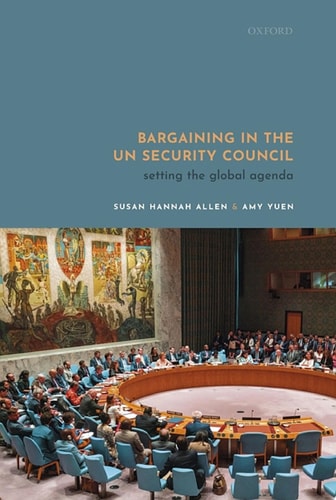
Bargaining in the UN Security Council: Setting the Global Agenda
0
0
As an Amazon Associate and affiliate partner, Menrva Books earns from qualifying purchases. Learn more
Author Description
Even after seventy-five years, the UN Security Council meets nearly every day. They respond to a range of threats to international peace and security, but not all threats. Why does the Security Council take up some issues for discussion and not others? What factors shape the Council's actions, if they take any action at all? Adapting insights from legislative bargaining, this book demonstrates that the agenda-setting powers granted in the institutional rules offer less powerful Council members the opportunity to influence the content of a resolution without jeopardizing its passage. The Council also decides when to conduct public or private diplomacy. The analysis shows how external factors like international and domestic public reactions motivate grandstanding behaviors and shape resolutions. New quantitative data on meetings and outside options provide support for these claims. The book also explores the dynamics of the formal analysis in three cases: North Korean nuclear proliferation, the negotiations leading up to NATO bombing in Serbia over Kosovo, and the elected member-led process to codify the principles of the Responsibility to Protect doctrine. The book argues that while the powerful veto members do have great influence over the Council, the rules of the most consequential security institution influence its policy outcomes, just as they do in any other international institution.
Menrva's Summary
THE THESIS
This book investigates the mechanisms of agenda-setting within the United Nations Security Council to determine why specific international threats are prioritized for discussion while others are ignored. Authors Susan H. Allen and Amy Yuen utilize legislative bargaining theory to analyze how institutional rules allow less powerful member states to exert influence over resolution content. By examining the interplay between formal procedures and external pressures, the authors argue that the Security Council functions as a structured bargaining environment where rules constrain even the most powerful veto-wielding members.
THE SCOPE MAP
What You Will Find
- Quantitative analysis of Security Council meeting frequency and outside diplomatic options
- Application of legislative bargaining models to international institutional behavior
- Case studies on North Korean nuclear proliferation, NATO intervention in Kosovo, and the Responsibility to Protect doctrine
Scope Limits
- Does not provide a comprehensive history of every Security Council resolution since inception
- Does not focus on the internal bureaucratic operations of the UN Secretariat
THE AUTHORITY PERSPECTIVE
Experts recognize this work as a rigorous application of formal political science methodology to the study of international organizations. Scholars frequently note the clarity with which the authors bridge the gap between abstract bargaining theory and the practical realities of high-stakes global diplomacy.
Page Count:
320
Publication Date:
2022-01-01
Publisher:
OUP Oxford
ISBN-10:
0192666606
ISBN-13:
9780192666604
Diplomacy
International relations
Public Policy
United Nations
Community Tags
Similar Books