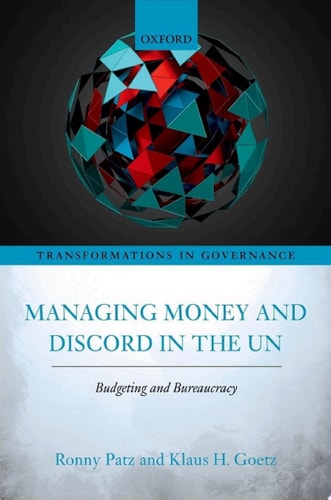
Managing Money and Discord in the UN: Budgeting and Bureaucracy
0
0
As an Amazon Associate and affiliate partner, Menrva Books earns from qualifying purchases. Learn more
Author Description
How do international organizations in the United Nations system put together their budgets? What is the role of complex principals - most notably member states - and the complex agents in the bureaucracies of international organizations in budgeting processes? And what does a focus on budgeting tell us about the changing nature of the system of international organizations? This book provides answers to these questions through a detailed examination of budgeting in the UN system. The analysis draws on both quantitative and qualitative observations for a total of 22 UN system organizations and detailed case studies for the United Nations, ILO, UNESCO, and WHO. The findings demonstrate the importance of three key organizational outcomes-- proceduralization, routinization, and budgetary segmentation - as international organizations grapple with managing discord over priorities as a result of complex principal-- agent constellations. Contrary to a common view of international bureaucracies as pathological organizations, core budget routines are mostly successfully maintained. However, principal constellations become more complex, notably through the rise of voluntary contributions and non-state donors; budgetary segmentation advances, in some cases even leading to the setting up of new international organizations; and budgeting and resource mobilization become ever more intertwined. As a consequence, the capacity of international bureaucracies to fulfil their budgeting responsibilities is stretched to the limits and beyond. Transformations in Governance is a major academic book series from Oxford University Press. It is designed to accommodate the impressive growth of research in comparative politics, international relations, public policy, federalism, and environmental and urban studies concerned with the dispersion of authority from central states to supranational institutions, subnational governments, and public-private networks. It brings together work that advances
Menrva's Summary
THE THESIS
This book investigates how international organizations within the United Nations system navigate the complexities of budgeting amidst conflicting priorities and bureaucratic constraints. Authors Klaus H. Goetz and Ronny Patz utilize a principal-agent framework to analyze how member states and internal bureaucracies interact during financial processes. By examining the tension between organizational stability and the influence of voluntary contributions, the authors argue that current budgetary practices are increasingly strained by the evolving nature of international resource mobilization.
THE SCOPE MAP
What You Will Find
- Comparative analysis of 22 distinct organizations within the UN system.
- Detailed case studies focusing on the United Nations, ILO, UNESCO, and WHO.
- A framework identifying three primary organizational outcomes: proceduralization, routinization, and budgetary segmentation.
Scope Limits
- The study does not provide a comprehensive history of all UN financial policies since the organization's inception.
- It does not offer prescriptive policy solutions for reforming UN budgetary structures.
THE AUTHORITY PERSPECTIVE
Experts recognize this work as a significant contribution to the study of international public administration and the mechanics of global governance. Readers frequently note the academic density of the prose, which is tailored for scholars and practitioners interested in the intersection of bureaucracy and international finance.
Page Count:
262
Publication Date:
2019-01-01
Publisher:
OUP Oxford
ISBN-10:
0192575325
ISBN-13:
9780192575326
Economics
Governance
Public Policy
International relations
United Nations
Community Tags
Similar Books