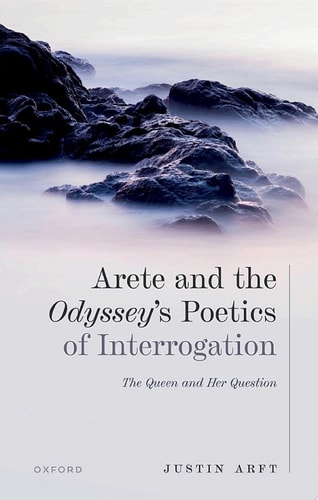
Arete and the Odyssey's Poetics of Interrogation: The Queen and Her Question
0
0
As an Amazon Associate and affiliate partner, Menrva Books earns from qualifying purchases. Learn more
Author Description
Arete and the Odyssey's Poetics of Interrogation explores how the enigmatic Phaeacian queen, Arete, is at the heart of an epic-scale "poetics of interrogation" used throughout the Odyssey to negotiate Odysseus' kleos, or epic renown. Arete's interrogation of Odysseus has been especially problematic in scholarship, but diachronic and synchronic analysis of similar interrogations across Indo-European, Orphic, and Greek epigrammatic corpora show that the "stranger's interrogation" is a formula that demands performance and negotiation of status. Within the Odyssey, this interrogation is part of an intraformular network used to generate kleos, and the queen's question initiates the longest and most complex negotiation of Odysseus' status in epic and memory. Arete's role as interrogator not only explains her strange authority and resonance with both Penelope and comparative afterlife figures, but it also establishes a gendered, agonistic tension between she and her husband, Alkinoos, that influences the structure, genre, and narratology of performances across the Phaeacian episode. This book reinterprets the Odyssey's central episode and challenges several assumptions about Nausikaa and Alkinoos' famed hospitality, even demonstrating how the Apologue is organized as a response to competing inquiries into Odysseus' fundamental status in tradition. The Odyssey ultimately navigates away from Odysseus' public reputation and roots his status in private memories, and Arete's carefully arranged interventions signal the larger process by which the Odyssey immortalizes Odysseus in poetry as a nostos hero. The queen and her question invite new applications of oral poetics that shed light on the structure, composition, and reperformance of the Odyssey.
Menrva's Summary
THE THESIS
This book investigates the role of the Phaeacian queen Arete as the central figure in a 'poetics of interrogation' that defines the negotiation of Odysseus' status within the Odyssey. Author Justin Arft, a scholar of Homeric epic and oral tradition, utilizes a combination of diachronic and synchronic analysis to examine the 'stranger's interrogation' as a recurring formulaic device. By situating the Phaeacian episode within broader Indo-European and Greek epigrammatic contexts, Arft argues that Arete's questioning is not merely a plot point but a structural mechanism that shapes the narrative's approach to kleos and memory.
THE SCOPE MAP
What You Will Find
- Comparative analysis of Indo-European, Orphic, and Greek epigrammatic interrogation formulas.
- A re-evaluation of the Phaeacian episode's influence on the Odyssey's overall narratology.
- Examination of the gendered, agonistic power dynamics between Arete and Alkinoos.
- Analysis of the Apologue as a response to competing traditional inquiries into Odysseus' identity.
Scope Limits
- The study focuses primarily on the Phaeacian episode and the specific function of Arete, rather than providing a comprehensive analysis of the entire Odyssey.
- The text assumes a high level of familiarity with Homeric scholarship and oral-formulaic theory.
THE AUTHORITY PERSPECTIVE
Scholars in the field of Homeric studies recognize this work as a specialized contribution to the understanding of oral poetics and the structural significance of minor characters. Readers frequently note the academic density of the prose and the rigorous application of comparative methodology to traditional epic formulas.
Page Count:
376
Publication Date:
2022-01-01
Publisher:
OUP Oxford
ISBN-10:
0192663607
ISBN-13:
9780192663603
Literary Criticism
Body Mind Spirit
Homeric Studies
Supernatural
Oral Poetics
Community Tags
Similar Books