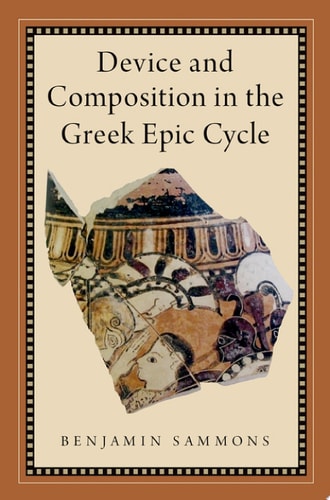
Device and Composition in the Greek Epic Cycle
0
0
As an Amazon Associate and affiliate partner, Menrva Books earns from qualifying purchases. Learn more
Author Description
From a corpus of Greek epics known in antiquity as the Epic Cycle, six poems dealt with the same Trojan War mythology as the Homeric poems. Though they are now lost, these poems were much read and much discussed in ancient times, not only for their content but for their mysterious relationship with the more famous works attributed to Homer. In Device and Composition in the Greek Epic Cycle, Benjamin Sammons shows that these lost poems belonged, compositionally, to essentially the same tradition as the Homeric poems. He demonstrates that various devices well-known from the Homeric epics were also fundamental to the narrative construction of these later works. Yet while the Cyclic poets constructed their works using the same traditional devices as Homer, they used these to different ends and with different results. Sammons argues that essential difference between Cyclic and Homeric poetry lies not in the fundamental building blocks from which they are constructed, but in the scale of these components relative to the overall structure of the poems. This approach sheds new light on the meaning of the few surviving verse fragments and on the overall form of the poems themselves. Narratives -- Catalogue and Catalogic -- Narrative Doublets -- Character Roles and Narrative Design -- Aristeia -- The Role of the Gods and the Divine. Benjamin Sammons. Includes bibliographical references and index.
Menrva's Summary
THE THESIS
This work investigates the compositional relationship between the lost poems of the Greek Epic Cycle and the Homeric epics. Benjamin Sammons, a scholar of classical literature, utilizes surviving verse fragments and ancient testimonies to argue that the Cyclic poets operated within the same traditional framework as Homer. He posits that while the fundamental building blocks of narrative construction remain consistent across both bodies of work, the Cyclic poets employed these devices at a different scale, resulting in distinct structural outcomes.
THE SCOPE MAP
What You Will Find
- Analysis of narrative techniques including catalogue, narrative doublets, and aristeia
- Examination of character roles and divine intervention in epic design
- Comparative study of Homeric versus Cyclic structural proportions
Scope Limits
- The study is constrained by the fragmentary nature of the Cyclic poems
- It does not provide a full reconstruction of the lost epics but focuses on compositional mechanics
THE AUTHORITY PERSPECTIVE
Scholars recognize this text as a significant contribution to the study of oral-formulaic composition and the structural analysis of archaic Greek poetry. Readers frequently note the academic density of the prose, which is intended for specialists in classical philology and epic tradition.
Page Count:
0
Publication Date:
1900-01-01
Publisher:
Oxford University Press,
ISBN-10:
0190614862
ISBN-13:
9780190614867
Homeric Studies
Epic Poetry
Literary Criticism
Community Tags
Other Editions(3)
Similar Books