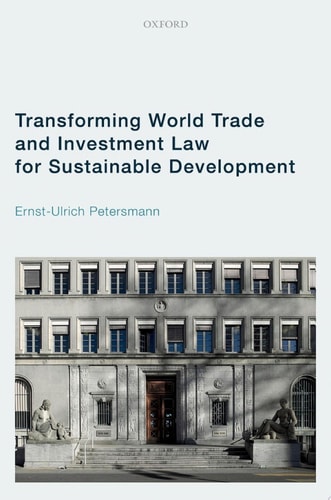
Transforming World Trade and Investment Law for Sustainable Development
0
0
As an Amazon Associate and affiliate partner, Menrva Books earns from qualifying purchases. Learn more
Author Description
Transforming World Trade and Investment Law for Sustainable Development explains why the 2030 UN Sustainable Development Agenda for "Transforming our World"--aimed at realizing universal human rights and the17 agreed sustainable development goals (SDGs)--requires transforming the UN and WTO legal systems, as well as international investment law and adjudication. UN and WTO law protect regulatory competition between diverse neo-liberal, state-capitalist, European ordo-liberal, and developing countries' conceptions of multilevel trade and investment regulation. However, geopolitical rivalries and trade wars increasingly undermine transnational rule of law and effective regulation of market failures, governance, and constitutional failures. Protecting the WTO legal and dispute settlement system remains essential for SDGs such as climate change mitigation measures and access to medical supplies and vaccines in global health pandemics. Investment law and adjudication must better reconcile governmental duties to protect human rights and decarbonize economies with the property rights of foreign investors. The constitutional, human rights, and environmental litigation in Europe enhances the legal accountability of democratic governments for protecting sustainable development. However, European economic constitutionalism has been rejected by neoliberalism, China's authoritarian state-capitalism, and many developing countries' governments. The more that regional economic orders (like the China-led Belt and Road networks) reveal heterogeneity and power politics block UN and WTO reforms, the more the US-led neoliberal world order risks disintegrating. UN and WTO law must promote private-public network governance and civil society participation in order to stabilize and de-politicize multilevel governance that protects SDGs and global public goods.
Menrva's Summary
THE THESIS
This work investigates the necessity of reforming international trade and investment legal frameworks to align with the 2030 UN Sustainable Development Agenda. Ernst Ulrich Petersmann, a scholar of international economic law, utilizes a constitutional and human rights-based framework to argue that current WTO and UN systems are insufficient to address modern market failures and geopolitical instability. He posits that integrating human rights protections and environmental accountability into global economic governance is essential for the survival of a rules-based international order.
THE SCOPE MAP
What You Will Find
- Analysis of the intersection between WTO law and the 17 UN Sustainable Development Goals.
- Examination of the conflict between foreign investor property rights and governmental duties to protect human rights.
- Comparative study of diverse economic models, including European ordo-liberalism, neoliberalism, and state-capitalism.
Scope Limits
- The text does not provide a detailed technical manual for specific trade litigation procedures.
- It does not offer a comprehensive history of the GATT, focusing instead on contemporary reform challenges.
THE AUTHORITY PERSPECTIVE
Experts recognize this text as a rigorous academic contribution to the field of international economic law and constitutionalism. Readers frequently note the high density of the prose and the author's sophisticated integration of political theory with legal doctrine.
Page Count:
368
Publication Date:
2022-01-01
Publisher:
OUP Oxford
ISBN-10:
0192672762
ISBN-13:
9780192672766
Economics
International Law
Professional Career & Trade
Trade Law
Community Tags
Similar Books