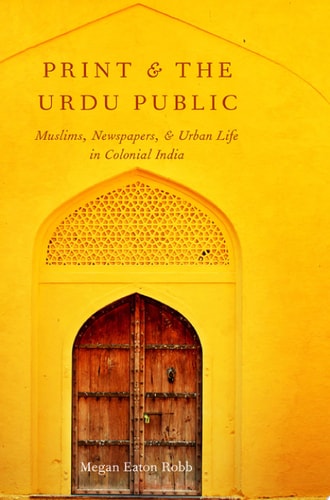
Print and the Urdu Public: Muslims, Newspapers, and Urban Life in Colonial India
0
0
As an Amazon Associate and affiliate partner, Menrva Books earns from qualifying purchases. Learn more
Author Description
In early twentieth century British India, prior to the arrival of digital medias and after the rise of nationalist political movements, a small-town paper from the margins of society became a key player in Urdu journalism. Published in the isolated market town of Bijnor, Madinah grew to hold influence across North India and the Punjab while navigating complex issues of religious and political identity. In Print and the Urdu Public, Megan Robb uses the previously unexamined perspective of the Madinah to consider Urdu print publics and urban life in South Asia. Through a discursive and material analysis of Madinah, the book explores how Muslims who had settled in ancestral qasbahs, or small towns, used newspapers to facilitate a new public consciousness. The book demonstrates how Madinah connected the Urdu newspaper conversation both explicitly and implicitly with Muslim identity and delineated the boundaries of a Muslim public conversation in a way that emphasized rootedness to local politics and small urban spaces. The case study of this influential but understudied newspaper reveals how a network of journalists with substantial ties to qasbahs produced a discourse self-consciously alternative to the Western-influenced, secularized cities. Megan Robb augments the analysis with evidence from contemporary Urdu, English, and Hindi papers, government records, private diaries, private library holdings, ethnographic interviews, and training materials for newspaper printers. This thoroughly researched volume recovers the erasure of qasbah voices and proclaims the importance of space and time in definitions of the public sphere in South Asia.Print and the Urdu Public demonstrates how an Urdu newspaper published from the margins became central to the Muslim public constituted in the first half of the twentieth century.
Menrva's Summary
THE THESIS
How did a small-town Urdu newspaper in colonial India shape the public consciousness and political identity of Muslims in the early twentieth century? Megan Eaton Robb, a scholar of South Asian history, investigates the influence of the newspaper Madinah to argue that qasbah-based journalism provided a distinct alternative to the secularized, Western-influenced discourse of major metropolitan centers. By analyzing the material and discursive practices of this publication, the author demonstrates how local print media facilitated a unique Muslim public sphere rooted in small-town urban life.
THE SCOPE MAP
What You Will Find
- Analysis of the newspaper Madinah as a primary case study for Urdu print culture.
- Examination of the intersection between religious identity, nationalist politics, and local urban geography.
- Methodology incorporating government records, private diaries, library archives, and ethnographic interviews.
Scope Limits
- The study focuses primarily on the first half of the twentieth century in North India and the Punjab.
- The research does not provide a comprehensive history of all Urdu journalism, focusing instead on the specific contributions of qasbah-based networks.
THE AUTHORITY PERSPECTIVE
Scholars in South Asian history and media studies recognize this work as a significant contribution to the understanding of regional print publics. Readers frequently note the academic density of the prose and the depth of the archival research presented throughout the volume.
Page Count:
259
Publication Date:
2020-01-01
Publisher:
Oxford University Press
ISBN-10:
0190089393
ISBN-13:
9780190089399
History
Religion
Islamic press
Asian History
Muslim Studies
Journalism history
Journalism
Islam
Muslims
Media Studies
Press
Asian Studies
Middle Eastern
Colonial India
Community Tags
Similar Books