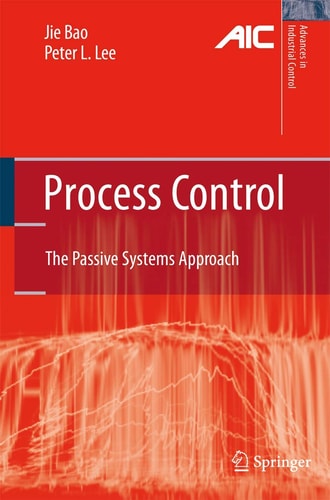
Process Control: The Passive Systems Approach
0
0
As an Amazon Associate and affiliate partner, Menrva Books earns from qualifying purchases. Learn more
Author Description
Process Control introduces an emerging area in process control – control system analysis and design based on the concept of passive systems. Passive systems are a class of processes that dissipate certain types of physical or virtual energy, defined by Lyapunov-like functions. Passivity and associated stability conditions form one of the cornerstones in control theory and have recently begun to be applied in process control. Defined as an input-output property, the concept of passivity implies stability conditions for interconnected systems. Passive systems are minimum phase and thus very easy to control via output feedback, even if they are highly nonlinear and coupled. Therefore, the passivity framework can be used in process input-output controllability analysis as well as control design. Here, the concept of passive systems is also linked to process thermodynamics to provide process engineers with insights into the physical bases of the above results. In this book, passivity-based developments in the areas of robust process control, decentralized control, fault tolerant control, process controllability analysis and nonlinear process control are addressed systematically for the first time. Written for the industrial, engineering and academic communities, the emphasis is placed on results that enhance insight and intuition. Application issues are illustrated by case studies in all the main chapters. MATLAB® routines for selected examples and a library of functions that implement the system analysis and control design methods developed in Process Control can be downloaded from springer.com. This book presents the reader with both the conceptual framework and practical tools for passivity-based system analysis and control.
Menrva's Summary
THE THESIS
This book introduces the concept of passive systems as a framework for analyzing and designing control systems, particularly within the field of process control. The authors, Jie Bao and Peter L. Lee, explore how passive systems, defined by Lyapunov-like functions that dissipate energy, offer inherent stability conditions. This property makes them amenable to control via output feedback, even when highly nonlinear and coupled. The book systematically addresses passivity-based developments in robust control, decentralized control, fault-tolerant control, controllability analysis, and nonlinear process control, aiming to enhance reader insight and intuition with practical case studies and downloadable MATLAB routines.
THE SCOPE MAP
- Analysis and design of control systems using the passive systems approach.
- Application of passivity and associated stability conditions to process control.
- Linkage between passive systems and process thermodynamics for physical insights.
- Systematic coverage of passivity-based developments in robust, decentralized, fault-tolerant, and nonlinear process control.
- Case studies illustrating application issues.
- MATLAB® routines and a library of functions for system analysis and control design.
THE AUTHORITY PERSPECTIVE
The book is written for industrial, engineering, and academic communities, with an emphasis on enhancing insight and intuition. It systematically addresses passivity-based developments in various areas of process control for the first time. Case studies are included to illustrate application issues, and supplementary MATLAB routines are available for download. The work provides readers with both the conceptual framework and practical tools for passivity-based system analysis and control.
Page Count:
253
Publication Date:
2010-10-21
Publisher:
Springer London
ISBN-10:
1849966699
ISBN-13:
9781849966696
Science & Technology
Non-Fiction
Science
Control systems
Engineering
Thermodynamics
Community Tags
Other Editions(2)
Similar Books


Reader Comments
Share Your Thoughts
No comments yet. Be the first to share your thoughts!