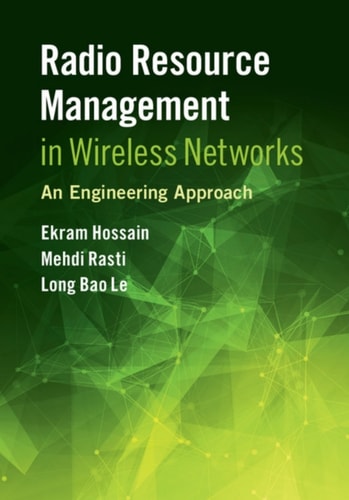
Radio Resource Management in Wireless Networks
0
0
As an Amazon Associate and affiliate partner, Menrva Books earns from qualifying purchases. Learn more
Author Description
Do you need to design efficient wireless communications systems? This unique text provides detailed coverage of radio resource allocation problems in wireless networks and the techniques that can be used to solve them. Covering basic principles and mathematical algorithms, and with a particular focus on power control and channel allocation, you will learn how to model, analyze, and optimize the allocation of resources in both physical and data link layers, and for a range of different network types. Both established and emerging networks are considered, including CDMA and OFDMA wireless networks, relay-based wireless networks, and cognitive radio networks. Numerous exercises help you put knowledge into practice, and provide the tools needed to address some of the current research problems in the field. This is an essential reference whether you are a graduate student, researcher or industry professional working in the field of wireless communication networks.
Menrva's Summary
THE THESIS
This text investigates the complex challenges of radio resource allocation in wireless networks and presents a comprehensive array of techniques for their resolution. The authors, drawing on their expertise in wireless communications, detail fundamental principles and mathematical algorithms, with a specific emphasis on power control and channel allocation. Readers will gain the ability to model, analyze, and optimize resource allocation across physical and data link layers for diverse network types. The book addresses both established and emerging networks, including CDMA, OFDMA, relay-based, and cognitive radio networks, providing practical exercises to solidify understanding and tackle current research problems.
THE SCOPE MAP
- Detailed coverage of radio resource allocation problems in wireless networks.
- Explanation of techniques for solving resource allocation problems.
- Focus on power control and channel allocation.
- Methods for modeling, analyzing, and optimizing resource allocation.
- Consideration of both physical and data link layers.
- Analysis of various network types including CDMA, OFDMA, relay-based, and cognitive radio networks.
- Numerous exercises to facilitate practical application and research.
THE AUTHORITY PERSPECTIVE
This book is positioned as an essential reference for graduate students, researchers, and industry professionals in wireless communication networks. Its detailed coverage of radio resource allocation, mathematical algorithms, and practical exercises suggests a rigorous academic and professional utility. The inclusion of both established and emerging network types indicates a comprehensive scope aimed at providing a thorough understanding of the field. The text is designed to equip readers with the tools necessary to address current research challenges.
Page Count:
234
Publication Date:
2017-04-27
Publisher:
Cambridge University Press
ISBN-10:
1108158838
ISBN-13:
9781108158831
Non-Fiction
Science & Technology
Science
Engineering
Telecommunications
Computer Science
Community Tags
Other Editions(2)

Similar Books