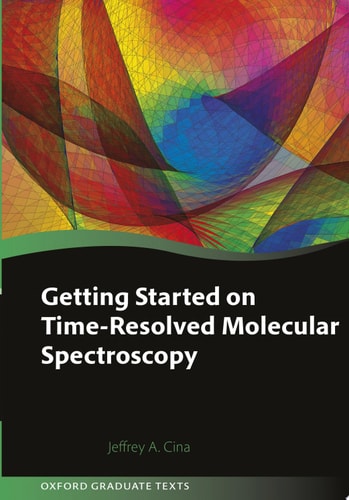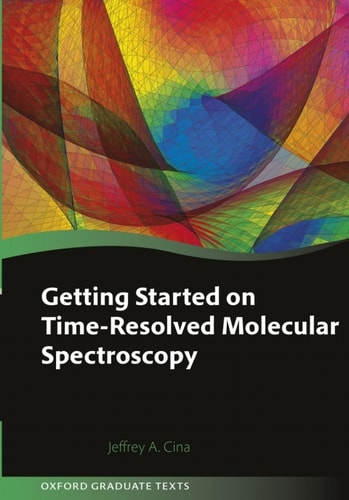
Getting Started on Time-Resolved Molecular Spectroscopy
0
0
As an Amazon Associate and affiliate partner, Menrva Books earns from qualifying purchases. Learn more
Author Description
This textbook provides an overview of the basics of ultrafast molecular spectroscopy starting from time-dependent quantum mechanical perturbation theory in Hilbert space. It emphasizes the dynamics of nuclear and electronic motion, initiated and monitored by femtosecond laser pulses, which underlie the generation of nonlinear optical signals and inform their interpretation. Topics include short-pulse electronic absorption, the molecular adiabatic approximation, transient-absorption spectroscopy, vibrational adiabaticity during conformational change, femtosecond stimulated Raman spectroscopy, multi-dimensional electronic spectroscopy and wave-packet interferometry, and two-dimensional wave-packet interferometry of electronic excitation-transfer systems. The treatment is based on time-dependent quantum mechanics as it is presented in graduate-level quantum mechanics courses. It is designed to be accessible to beginning practitioners of ultrafast spectroscopy and is meant to serve as a bridge to more advanced treatises and research publications. Numerous exercises are embedded in the text to explore and expand upon the physical ideas encountered in this important research field.
Menrva's Summary
THE THESIS
This text investigates the fundamental principles of ultrafast molecular spectroscopy by applying time-dependent quantum mechanical perturbation theory to nuclear and electronic motion. Author Jeffrey A. Cina, a specialist in chemical physics, utilizes a framework rooted in graduate-level quantum mechanics to explain how femtosecond laser pulses initiate and monitor molecular dynamics. The book serves as a bridge between foundational quantum theory and the practical interpretation of nonlinear optical signals in research settings.
THE SCOPE MAP
What You Will Find
- Theoretical foundations of time-dependent quantum mechanical perturbation theory in Hilbert space
- Analysis of short-pulse electronic absorption and molecular adiabatic approximation
- Methodologies for transient-absorption and femtosecond stimulated Raman spectroscopy
- Techniques for multi-dimensional electronic spectroscopy and wave-packet interferometry
- Embedded exercises designed to reinforce physical concepts and mathematical derivations
Scope Limits
- Does not provide an exhaustive survey of all experimental hardware configurations
- Assumes the reader possesses a prior working knowledge of graduate-level quantum mechanics
THE AUTHORITY PERSPECTIVE
Experts identify this work as a focused pedagogical resource for graduate students and beginning researchers entering the field of ultrafast dynamics. Readers frequently note the technical density of the prose, which requires a strong background in quantum mechanics to fully grasp the presented derivations.
Page Count:
512
Publication Date:
2022-01-01
Publisher:
OUP Oxford
ISBN-10:
0192677055
ISBN-13:
9780192677051
Science
Chemistry
Spectroscopy
Analytical Chemistry
Earth Sciences
textbook
Physics