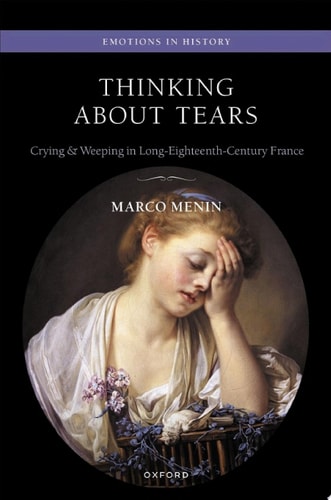
Thinking About Tears: Crying and Weeping in Long-Eighteenth-Century France
0
0
As an Amazon Associate and affiliate partner, Menrva Books earns from qualifying purchases. Learn more
Author Description
A crucial period for the birth of the modern subject, France's 'long eighteenth century' (approximately 1650-1820) was an era marked by the formulation of a new aesthetic and ethical code revolving around the intensification of emotions and the hyperbolic use of weeping. Precisely because tears are not a simple biological fact but rather hang suspended between natural immediacy, on one side, and cultural artifice, on the other, the analysis of crying came to represent an exemplary testing ground for investigations into the enigmatic relations binding the realm of physiology to that of psychology. Thinking About Tears explores how the link between tears and sensibility in France's long eighteenth century helps shed light on the process through which the European emotional lexicon has been built: from viewing tears as governed by the sphere of 'passions' and 'feelings', thinkers began to view crying as first a matter of sensibility and then of sensiblerie (a pathological excess of sensibility), thereby presupposing an intimate connection with the category of 'sentiments'. For this reason, this volume examines not only or even primarily the actual emotion of crying, but also the attempt to think about and explain this feeling. Drawing on a wide range of early modern philosophical, medical, religious, and literary texts-including moral treatises on the passions, medical textbooks, letters, life-writings, novels, and stage-plays-Thinking About Tears reveals another side to a period that has too often been saddled with the cursory label of 'the age of reason'.
Menrva's Summary
THE THESIS
This book investigates how the act of weeping functioned as a critical intersection between physiology, psychology, and cultural expression in France between 1650 and 1820. Marco Menin, a scholar of early modern intellectual history, utilizes a multidisciplinary approach to examine how French thinkers transitioned from viewing tears as raw passion to interpreting them through the lenses of sensibility and pathological sensiblerie. By analyzing the evolution of the emotional lexicon, the author argues that the eighteenth century was not merely an age of reason, but a period defined by the complex codification of human sentiment.
THE SCOPE MAP
What You Will Find
- Analysis of the transition from 'passions' to 'sensibility' and 'sensiblerie' in French thought.
- Examination of the tension between biological reflex and cultural performance in weeping.
- Synthesis of diverse primary sources including moral treatises, medical textbooks, and literary works.
Scope Limits
- The study is geographically restricted to France and chronologically bounded by the long eighteenth century (1650-1820).
- The work focuses primarily on the intellectual and philosophical discourse surrounding tears rather than a sociological history of actual crying practices.
THE AUTHORITY PERSPECTIVE
Scholars recognize this work as a significant contribution to the history of emotions, particularly for its ability to bridge the gap between medical theory and literary expression. Readers frequently note the academic density of the prose, which is best suited for those familiar with early modern French intellectual history.
Page Count:
335
Publication Date:
2022-01-01
Publisher:
OUP Oxford
ISBN-10:
0192679333
ISBN-13:
9780192679338
Philosophy
Psychology
History
18th century
Cultural History
Europe
European History
Community Tags
Similar Books