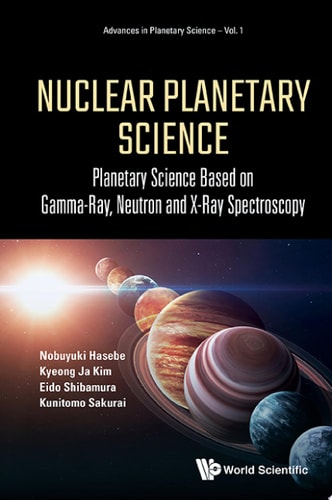
Nuclear Planetary Science: Planetary Science Based on Gamma-Ray, Neutron and X-Ray Spectroscopy
0
0
As an Amazon Associate and affiliate partner, Menrva Books earns from qualifying purchases. Learn more
Author Description
Nuclear planetary science has come to play an important role in our understanding of the origin and evolution of the planetary bodies in our solar system. A newly established branch of planetary science, its study aids in humankind's exploration of the present states of the structures of various planetary bodies (including the Earth), their atmospheres and their satellites, as well as small celestial bodies (e.g. asteroids), through direct observation. Knowing the elemental composition of the planetary bodies is essential in order to understand the formation and evolution of planetary bodies — just as important as it is to know the mass, radius, density and orbit of the celestial body. Suitable for students and specialists interested in the much wider field of Earth and Planetary Science, topics related to the planets and asteroids in the solar system are dealt with in this book. Techniques related to nuclear planetary science's nuclear cosmochemical and geological methods are also covered in this book.
Menrva's Summary
THE THESIS
This book investigates the role of nuclear spectroscopy techniques in understanding the composition, origin, and evolution of planetary bodies. It details how gamma-ray, neutron, and X-ray spectroscopy are applied to analyze the elemental makeup of planets, moons, and asteroids, providing crucial insights into their formation and development. The work covers both direct observation methods and the underlying principles of nuclear cosmochemical and geological analysis.
THE SCOPE MAP
- Introduction to Planetary Science and Nuclear Planetary Science
- Principles of Gamma-Ray, Neutron, and X-Ray Spectroscopy
- Details on Gamma-Ray Detectors, Neutron Detectors, and Active Fluorescence X-Ray Spectrometers
- Methods for Numerical Simulation and Laboratory Experiments in Radionuclide Production
- Coverage of Thick-Target Experiments for Nuclear Planetary Exploration
- Case studies of Nuclear Planetary Exploration missions including Apollo, Lunar Prospector, Kaguya, Chandrayaan-1, and Mars Nuclear missions.
THE AUTHORITY PERSPECTIVE
This book is positioned as a foundational text for students and specialists in Earth and Planetary Science, offering a comprehensive overview of nuclear spectroscopy's application in planetary research. The detailed content suggests a rigorous approach to understanding elemental composition and its implications for planetary formation and evolution. It appears to cover both theoretical principles and practical applications through various space missions.
Page Count:
180
Publication Date:
2017-09-25
Publisher:
World Scientific Publishing Company
ISBN-10:
9813209720
ISBN-13:
9789813209725
Science
Non-Fiction
Planetary Science
Astrophysics
Geology
Astronomy
Spectroscopy
Community Tags
Similar Books