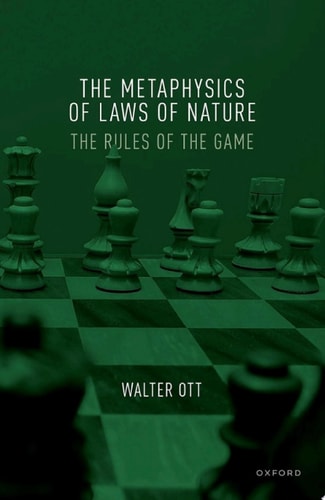
The Metaphysics of Laws of Nature: The Rules of the Game
0
0
As an Amazon Associate and affiliate partner, Menrva Books earns from qualifying purchases. Learn more
Author Description
It can seem obvious that we live in a world governed by laws of nature, yet it was not until the seventeenth century that the concept of a law came to the fore. Ever since, it has been attended by controversy: what does it mean to say that Boyle's law governs the expansion of a gas, or that the planets obey the law of gravity? Laws are rules that permit calculations and predictions. What does the universe have to be like, if it is to play by them? This book sorts the most prominent answers into three families. Laws first arose in a theological context; they govern events only because God enforces them. Those wishing to reverse the order of explanation, and argue that the powers of objects fix the laws, struggled to claim for themselves the results of new science. The stand-off between these two families bred a third which rejects any kind of enforcer for the laws. On this view, laws summarize events; they do not govern anything. This book traces the fortunes of the three families, from their origins to the present day. It uses objections - and the revisions needed to answer them - to produce the best representative of each. Along the way, it tries to settle the rules of this game, the debate over laws of nature. What should we expect from an account of laws? The book aims to help readers develop their own desiderata and judge the merits of the competing positions.
Menrva's Summary
THE THESIS
This book investigates the ontological status of laws of nature by examining the historical and conceptual frameworks that define how the universe operates. Walter Ott, a philosopher specializing in early modern philosophy and metaphysics, analyzes the evolution of the concept of natural laws from their seventeenth-century theological origins to contemporary debates. He argues that the discourse surrounding laws of nature can be categorized into three distinct families: theological enforcement, object-based powers, and the regularity view, which posits that laws merely summarize events rather than govern them.
THE SCOPE MAP
What You Will Find
- A historical survey of the development of natural law concepts from the seventeenth century to the present.
- A tripartite classification system for metaphysical theories of laws.
- Critical analysis of objections and subsequent theoretical revisions for each major position.
Scope Limits
- The text does not provide a comprehensive history of all scientific laws, focusing instead on the metaphysical interpretation of the concept of law itself.
- It does not offer a definitive solution to the problem of induction or specific empirical scientific proofs.
THE AUTHORITY PERSPECTIVE
Scholars and students of philosophy frequently note the clarity with which Ott navigates complex metaphysical terrain, making it a useful resource for those interested in the intersection of history and philosophy of science. Experts highlight this as a structured, accessible entry point for understanding the competing frameworks that define current debates on natural laws.
Page Count:
326
Publication Date:
2022-01-01
Publisher:
OUP Oxford
ISBN-10:
0192675370
ISBN-13:
9780192675378
Philosophy
Philosophy history
Philosophy of
Metaphysics
Community Tags
Similar Books