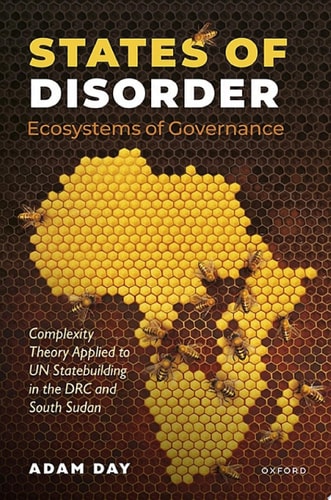
States of Disorder, Ecosystems of Governance: Complexity Theory Applied to UN Statebuilding in the DRC and South Sudan
0
0
As an Amazon Associate and affiliate partner, Menrva Books earns from qualifying purchases. Learn more
Author Description
Today's vision of world order is founded upon the concept of strong, well-functioning states, in contrast to the destabilizing potential of failed or fragile states. This worldview has dominated international interventions over the past 30 years as enormous resources have been devoted to developing and extending the governance capacity of weak or failing states, hoping to transform them into reliable nodes in the global order. But with very few exceptions, this project has not delivered on its promise: countries like Somalia, Afghanistan, South Sudan, and the Democratic Republic of the Congo (DRC) remain mired in conflict despite decades of international interventions. States of Disorder addresses the question, 'Why has UN state-building so consistently failed to meet its objectives?'. It proposes an explanation based on the application of complexity theory to UN interventions in South Sudan and DRC, where the UN has been tasked to implement massive stabilization and state-building missions. Far from being ''ungoverned spaces," these settings present complex, dynamical systems of governance with emergent properties that allow them to adapt and resist attempts to change them. UN interventions, based upon assumptions that gradual increases in institutional capacity will lead to improved governance, fail to reflect how change occurs in these systems and may in fact contribute to underlying patterns of exclusion and violence. Based on more than a decade of the author's work in peacekeeping, this book offers a systemic mapping of how governance systems work, and indeed work against, UN interventions. Pursuing a complexity-driven approach instead helps to avoid unintentional consequences, identifies meaningful points of leverage, and opens the possibility of transforming societies from within.
Menrva's Summary
THE THESIS
This book investigates why United Nations state-building missions have consistently failed to achieve their objectives in fragile contexts by applying complexity theory to the governance systems of the Democratic Republic of the Congo and South Sudan. Adam Day, drawing on over a decade of direct experience in international peacekeeping, argues that these regions are not 'ungoverned spaces' but rather complex, dynamical systems that actively adapt to and resist external intervention. He posits that the standard international approach of incrementally building institutional capacity is fundamentally flawed because it ignores the emergent properties of these systems, often inadvertently reinforcing patterns of violence and exclusion.
THE SCOPE MAP
What You Will Find
- Application of complexity theory and dynamical systems analysis to international state-building.
- A systemic mapping of governance structures in the DRC and South Sudan.
- Analysis of how external interventions interact with local power dynamics.
Scope Limits
- The study focuses specifically on UN-led stabilization missions rather than broader private or non-UN NGO interventions.
- The analysis does not provide a comprehensive history of all conflicts in the region, but rather uses these two cases to illustrate the systemic failure of current state-building models.
THE AUTHORITY PERSPECTIVE
Experts in international relations and conflict resolution recognize this work as a significant critique of traditional top-down intervention strategies. Readers frequently note the academic density of the prose, which effectively bridges the gap between abstract systems theory and the practical realities of field-based peacekeeping operations.
Page Count:
225
Publication Date:
2022-01-01
Publisher:
OUP Oxford
ISBN-10:
0192678736
ISBN-13:
9780192678737
International relations
Peacekeeping
Conflict Studies
Governance
Complexity Theory
Community Tags
Similar Books