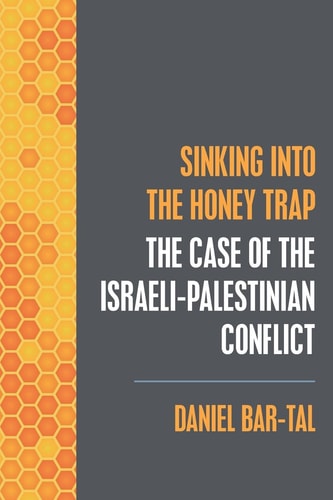
Sinking Into the Honey Trap: The Case of the Israeli-Palestinian Conflict
0
0
As an Amazon Associate and affiliate partner, Menrva Books earns from qualifying purchases. Learn more
Author Description
Sinking into the Honey Trap: The Case of the Israeli-Palestinian Conflict describes how Israeli society has positioned itself in the comfort zone, ignoring the reality in which it exists. It is about the story leaders tell us and is accepted by most people. This story shapes the consciousness of Israeli Jewish society by presenting half truths about the past, hiding the present and describing a deceptive vision for the future. Sinking into the Honey Trap explains the mechanisms that allow Israelis to ignore reality and to live in a situation that prolongs the conflict with the Palestinians and postpones the solution to an unseen future with ongoing violence. The book describes the political forces that have driven Israel to advance the occupation, settling Jews on the West Bank, outside of Israel's internationally recognized borders. Israeli society is paying a heavy price for the continuation of the conflict - not only in loss of life, emotional health problems and economic costs, but also in the deterioration of democracy and morality that accelerates the development of an authoritarian regime characterized by extreme nationalism and intense religiosity. This process has also occurred in other locations engulfed in intractable conflict, including Turkey, Russia, India, and Rwanda. In these cases, societies have been sinking into the honey trap. Daniel Bar-Tal is Professor Emeritus at the School of Education, Tel Aviv University. His research interest is in political and social psychology studying socio-psychological foundations of intractable conflicts and peace building. His most influential theoretical contribution is the development of a systematic and holistic theory of the dynamics of interethnic bloody and lasting conflicts: how they erupt, escalate and possibly de-escalate, are resolved peacefully and even reconciled. In addition, he is an authority on the Israeli-Arab/Palestinian conflict, suggesting a comprehensive interdisciplinary analysis
Menrva's Summary
THE THESIS
The book investigates how Israeli society has perpetuated the Israeli-Palestinian conflict by adhering to a self-constructed narrative that obscures present realities and future consequences. Daniel Bar-Tal, a professor emeritus of political and social psychology, argues that this narrative, built on half-truths and deceptive visions, allows Israelis to remain in a comfort zone, thereby prolonging the conflict and delaying a resolution. The book details the political forces driving the occupation of the West Bank and the severe price Israeli society pays, including loss of life, emotional distress, economic costs, and the erosion of democracy and morality, leading to an authoritarian regime. Bar-Tal draws parallels to similar societal patterns observed in other intractable conflict zones like Turkey, Russia, India, and Rwanda.
THE SCOPE MAP
- Analysis of the 'comfort zone' narrative within Israeli society regarding the Israeli-Palestinian conflict.
- Examination of the role of leadership-generated stories and their societal acceptance.
- Explanation of the psychological mechanisms that enable Israelis to ignore conflict realities.
- Discussion of the political forces driving the occupation and settlement of the West Bank.
- Assessment of the societal costs of prolonged conflict: loss of life, emotional health, economic impact, and democratic/moral deterioration.
- Comparative analysis of similar societal patterns in intractable conflicts in Turkey, Russia, India, and Rwanda.
- Author's theoretical contributions to the dynamics of interethnic conflicts and peacebuilding.
THE AUTHORITY PERSPECTIVE
The book is presented as a critical analysis of Israeli society's engagement with the Israeli-Palestinian conflict, focusing on the psychological and political mechanisms that sustain it. The author, Daniel Bar-Tal, draws upon his extensive background in political and social psychology to dissect the narratives that shape public consciousness and perpetuate the occupation. The work aims to explain how societies become entrenched in intractable conflicts, leading to significant societal costs and a decline in democratic and moral standards. By comparing Israel's situation to other conflict-ridden nations, the book seeks to illuminate the common pathways into what it terms the 'honey trap' of prolonged conflict.
Page Count:
466
Publication Date:
2023-01-01
Publisher:
Westphalia Press
ISBN-10:
1637237162
ISBN-13:
9781637237168
History
Politics
Non-Fiction
Sociology
Community Tags
Similar Books