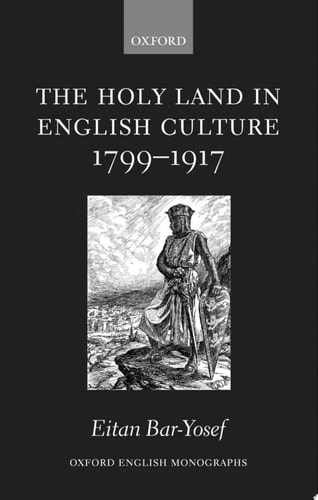
The Holy Land in English Culture 1799-1917
0
0
As an Amazon Associate and affiliate partner, Menrva Books earns from qualifying purchases. Learn more
Author Description
The dream of building Jerusalem in England's green and pleasant land has long been a quintessential part of English identity and culture: but how did this vision shape the Victorian encounter with the actual Jerusalem in the Middle East? The Holy Land in English Culture 1799-1917 offers a new cultural history of the English fascination with Palestine in the long nineteenth century, from Napoleon's failed Mediterranean campaign of 1799, which marked a new era in the British involvement in the land, to Allenby's conquest of Jerusalem in 1917. Bar-Yosef argues that the Protestant tradition of internalizing Biblical vocabulary - 'Promised Land', 'Chosen People', 'Jerusalem' - and applying it to different, often contesting, visions of England and Englishness evoked a unique sense of ambivalence towards the imperial desire to possess the Holy Land. Popular religious culture, in other words, was crucial to the construction of the orientalist discourse: so crucial, in fact, that metaphorical appropriations of the 'Holy Land' played a much more dominant role in the English cultural imagination than the actual Holy Land itself. As it traces the diversity of 'Holy Lands' in the Victorian cultural landscape - literal and metaphorical, secular and sacred, radical and patriotic, visual and textual - this study joins the ongoing debate about the dissemination of imperial ideology. Drawing on a wide array of sources, from Sunday-school textbooks and popular exhibitions to penny magazines and soldiers' diaries, the book demonstrates how the Orientalist discourse functions - or, to be more precise, malfunctions - in those popular cultural spheres that are so markedly absent from Edward Said's work: it is only by exploring sources that go beyond the highbrow, the academic, or the official, that we can begin to grasp the limited currency of the orientalist discourse in the metropolitan centre, and the different meanings it could hold for different social groups. As such, The Holy Land
Menrva's Summary
THE THESIS
This book investigates how the English cultural imagination of the Holy Land, particularly Jerusalem, influenced their perception and engagement with the actual region during the long nineteenth century. Eitan Bar-Yosef examines the period from Napoleon's 1799 campaign to the British conquest of Jerusalem in 1917, arguing that the internalization of biblical language and its application to English identity created an ambivalence towards imperial ambitions in Palestine. The study posits that these metaphorical appropriations of the 'Holy Land' held greater sway in the English cultural imagination than the physical territory itself. By analyzing a diverse range of popular and textual sources, the book explores the functioning and occasional malfunction of Orientalist discourse in less-examined popular cultural spheres.
THE SCOPE MAP
- Explores the period from 1799 to 1917, focusing on British involvement in the Holy Land.
- Analyzes the impact of Protestant traditions and biblical vocabulary on English identity and perceptions of England.
- Investigates the ambivalence towards imperial desires to possess the Holy Land.
- Examines the role of popular religious culture in constructing Orientalist discourse.
- Traces the diversity of 'Holy Lands' in the Victorian cultural landscape, both literal and metaphorical.
- Draws on a wide array of sources including Sunday-school textbooks, popular exhibitions, penny magazines, and soldiers' diaries.
- Discusses the dissemination of imperial ideology through popular cultural spheres.
- Contrasts the analysis of popular cultural spheres with the focus on highbrow and academic sources in Edward Said's work.
THE AUTHORITY PERSPECTIVE
The book offers a novel cultural history of English fascination with Palestine during the nineteenth century, arguing that metaphorical appropriations of the 'Holy Land' were more influential than the actual territory. It highlights the crucial role of popular religious culture in shaping Orientalist discourse and examines the dissemination of imperial ideology through various cultural spheres. The study is noted for its exploration of sources beyond the academic and official, providing insight into the varied meanings of Orientalism for different social groups. This approach allows for a nuanced understanding of how Orientalist discourse functioned, or malfunctioned, in popular culture.
Page Count:
334
Publication Date:
2005-10-27
Publisher:
Oxford University Press Academic UK
ISBN-10:
0191555576
ISBN-13:
9780191555572
Non-Fiction
History
Victorian Era
Cultural History
British Empire
Orientalism
Community Tags
Similar Books