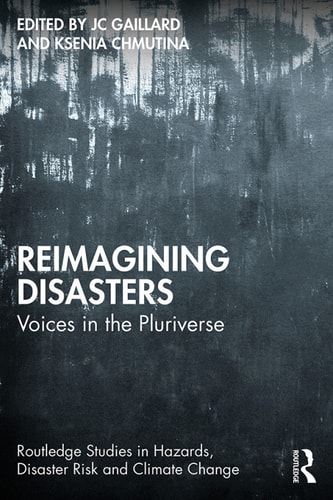
Reimagining Disasters
0
0
As an Amazon Associate and affiliate partner, Menrva Books earns from qualifying purchases. Learn more
Author Description
Reimagining Disasters builds on the momentum gained by the 2019 Disaster Studies Manifesto, which aims to inspire and inform more respectful, reciprocal and genuine relationships between home and visiting researchers in disaster studies. The book challenges normative understandings of disaster and moves away from the hegemony of Western ontologies and epistemologies in understanding harm, hardship and suffering, that is, what we usually call ‘disaster’. It consists of one theoretical chapter and five case studies from Chile, the Philippines, Zimbabwe, India and Nepal. The initial theoretical chapter revisits and contests the concept of ‘natural hazard’ as an underpinning and universal prerequisite for disasters to occur. The subsequent empirical studies led by home and indigenous scholars draw upon local concepts and methodologies to revisit, challenge and contest the concept of ‘disaster’ and how people experience hardship, harm and suffering. Overall, this book shows that it is possible to conduct more just, grounded and relevant disaster studies that reflect local perspectives and priorities and challenge the established notions of power. It is an essential read for students and scholars interested in disaster and postcolonial studies.
Menrva's Summary
THE THESIS
This book challenges Western-centric views of disaster by centering local knowledge and experiences. Reimagining Disasters builds upon the 2019 Disaster Studies Manifesto to foster more equitable relationships between researchers and communities. It critiques the concept of 'natural hazard' and explores how local ontologies and epistemologies offer alternative understandings of harm and suffering. The work advocates for more just, grounded, and relevant disaster studies that prioritize local perspectives and challenge established power dynamics.
THE SCOPE MAP
- Critique of the concept of 'natural hazard' as a universal prerequisite for disasters.
- Exploration of normative understandings of disaster, harm, hardship, and suffering.
- Five case studies from Chile, the Philippines, Zimbabwe, India, and Nepal.
- Emphasis on local concepts and methodologies in disaster research.
- Centering of home and indigenous scholars in empirical studies.
- Revisiting and contesting the concept of 'disaster' through lived experiences.
- Advocacy for more just, grounded, and relevant disaster studies.
- Challenge to established notions of power in disaster research.
THE AUTHORITY PERSPECTIVE
The book is positioned as an essential read for students and scholars in disaster and postcolonial studies, aiming to shift the field towards more equitable and locally-grounded research practices. Its theoretical chapter and diverse case studies are designed to contest dominant Western perspectives on disaster. The work seeks to demonstrate the possibility of conducting disaster studies that are more relevant and reflective of local priorities and experiences. By centering indigenous and home-grown scholarship, it challenges established power structures within the academic discipline.
Page Count:
0
Publication Date:
2026-03-09
Publisher:
Taylor & Francis
ISBN-10:
1040872808
ISBN-13:
9781040872802
Politics
Non-Fiction
History
Sociology
Community Tags
Similar Books