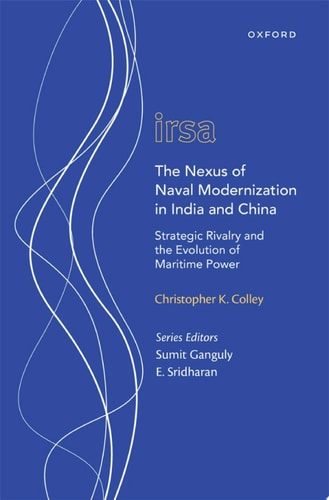
The Nexus of Naval Modernization in India and China: Strategic Rivalry and the Evolution of Maritime Power
0
0
As an Amazon Associate and affiliate partner, Menrva Books earns from qualifying purchases. Learn more
Author Description
Naval modernization is an extremely expensive, time-consuming, and a relatively rare phenomenon. Scholars have proposed various arguments to explain this process ranging from bureaucratic politics, to nationalism, and to the security dilemma. The Nexus of Naval Modernization in India and China demonstrates that from 1990 until 2020, the primary driver of naval modernization resulted from a strategic rivalry. Key to strategic rivalries is perceived threat perceptions that cause decision makers to prepare for worst-case scenarios when trying to decipher their enemy's behaviour. When a state believes it is threatened by a rival's naval power it is likely to pursue its own form of naval modernization for self-protection. Importantly, rivalries do not exist in a vacuum and are frequently linked. This project will reveal how the interconnected nature of rivalries can also cause naval modernization. Through a close examination of scholarly works, government documents, and in-depth focused interviews with experts based in India, China, Australia, and the U.S. Colley argues that while strategic rivalry is not the only driver of naval modernization, it is the most compelling explanation. Other arguments are frequently embedded within the strategic rivalry model and thus are best seen as only partial drivers. This study contributes to the rivalry research program as well as the policy and security studies literatures.
Menrva's Summary
THE THESIS
This book investigates the primary drivers of naval modernization in India and China, arguing that strategic rivalry is the most compelling explanation for the rapid expansion of maritime power between 1990 and 2020. Christopher K. Colley, a specialist in international security, utilizes a framework centered on threat perception and the security dilemma to analyze how states prepare for worst-case scenarios. By synthesizing government documentation and expert interviews, the author demonstrates that while factors like nationalism and bureaucratic politics play a role, they are largely subordinate to the overarching dynamics of strategic competition.
THE SCOPE MAP
What You Will Find
- Analysis of naval modernization trends from 1990 to 2020
- A theoretical framework linking interconnected strategic rivalries to military procurement
- Primary source evidence derived from government documents and expert interviews
Scope Limits
- The study does not provide a comprehensive history of all naval technological developments
- It does not focus on domestic economic policy independent of its relation to naval rivalry
THE AUTHORITY PERSPECTIVE
Experts highlight this work as a significant contribution to the study of rivalry and security dynamics in South Asia. Readers frequently note the academic rigor and the clarity with which the author integrates complex geopolitical theories into a coherent argument.
Page Count:
295
Publication Date:
2022-01-01
Publisher:
OUP Oxford
ISBN-10:
0192689355
ISBN-13:
9780192689351
Geopolitics
International relations
Military History
Asian Studies
Naval strategy
Community Tags
Similar Books