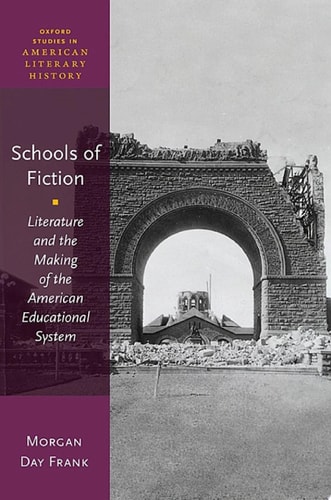
Schools of Fiction: Literature and the Making of the American Educational System
0
0
As an Amazon Associate and affiliate partner, Menrva Books earns from qualifying purchases. Learn more
Author Description
In Schools of Fiction, Morgan Day Frank considers a bizarre but integral feature of the modern educational experience: that teachers enthusiastically teach literary works that have terrible things to say about school. From Ishmael's insistence in Herman Melville's Moby-Dick that "a whale-ship was my Yale College and my Harvard," to the unnamed narrator's expulsion from his southern college in Ralph Ellison's Invisible Man, the most frequently taught books in the English curriculum tend to be those that cast the school as a stultifying and inhumane social institution. Why have educators preferred the anti-scholasticism of the American romance tradition to the didacticism of sentimentalists? Why have they organized "African American literature" as a discursive category around texts that despaired of the post-Reconstruction institutional system? Why did they start teaching novels, that literary form whose "very nature," in Mikhail Bakhtin's words, is "not canonic"? Reading literature in class is a paradoxical undertaking that, according to Day Frank, has proved foundational to the development of American formal education over the last two centuries, allowing the school to claim access to a social world external to itself. By drawing attention to the transformative effect literature has had on the school, Schools of Fiction challenges some of our core assumptions about the nature of cultural administration and the place of English in the curriculum. The educational system, Day Frank argues, has depended historically on the cultural objects whose existence it is ordinarily thought to govern and the academic subject it is ordinarily thought to have marginalized.
Menrva's Summary
THE THESIS
This book investigates the historical paradox of why the American educational system has consistently prioritized the teaching of literary works that critique or reject the institution of schooling itself. Morgan Day Frank, an academic specializing in American literary history, examines the structural evolution of the English curriculum over the last two centuries. By analyzing the tension between institutional administration and the anti-scholastic nature of the American literary canon, the author argues that schools have utilized these critical texts to project an image of intellectual freedom and social relevance that the institutions themselves often lack.
THE SCOPE MAP
What You Will Find
- Historical analysis of the integration of novels into the American classroom.
- Examination of the discursive construction of categories like African American literature.
- Theoretical framework regarding the relationship between cultural administration and literary canonization.
Scope Limits
- The study focuses primarily on the American educational system and does not provide a comparative analysis of international pedagogical models.
- The text does not offer a practical guide for curriculum design or classroom instruction.
THE AUTHORITY PERSPECTIVE
Scholars in the field of literary history identify this work as a significant contribution to understanding the institutionalization of American letters. Readers frequently note the academic density of the prose, which is intended for an audience familiar with literary theory and educational history.
Page Count:
611
Publication Date:
2022-01-01
Publisher:
OUP Oxford
ISBN-10:
0192693166
ISBN-13:
9780192693167
Education - History
Educational Foundations
Academic History
Professional Career & Trade
Literary Criticism
American
Community Tags
Similar Books