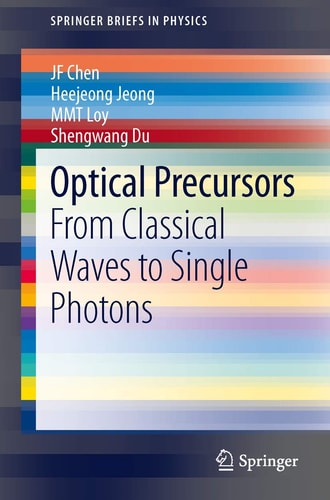
Optical Precursors From Classical Waves to Single Photons
0
0
As an Amazon Associate and affiliate partner, Menrva Books earns from qualifying purchases. Learn more
Author Description
Ever since Einstein’s special relativity in 1905, the principle of invariant light speed in vacuum has been attracting attention from a wide range of disciplines. How to interpret the principle of light speed? Is light referred to continuous light, or light pulse with definite boundaries? Recent discovery of superluminal medium triggered vigorous discussion within the Physics community. Can communication via such “superluminal channel” break the speed limit and thus violate causality principle? Or, will a single photon, which is not governed by classical laws of Physics, tend to break the speed limit? To solve these problems, this Brief brings in Optical Precursors, the theoretical works for which started as early as 1914. This is a typical optical phenomenon combining wave propagation theory and light-wave interaction. Both theory and experimental works are covered in this Brief. The study of precursor verifies that the effective information carried by light pulses can never exceed the speed of light in vacuum- c. Further, through observation from nonclassical single photon source, the precursor rules out the probability of a single photon traveling with the speed, breaking the classical limit.
Menrva's Summary
THE THESIS
This book investigates the nature of light speed and causality by examining optical precursors, phenomena that bridge classical wave propagation and quantum mechanics. The authors explore the long-standing debate surrounding Einstein's principle of invariant light speed, questioning whether it applies to continuous light or discrete photons. By analyzing theoretical and experimental works on optical precursors, the book addresses the implications of superluminal media and the behavior of single photons in relation to the speed of light in a vacuum, aiming to resolve whether information can truly exceed this limit or if causality can be violated.
THE SCOPE MAP
- Theoretical foundations of optical precursors dating back to 1914.
- Experimental verification of wave propagation theory and light-wave interaction.
- Analysis of superluminal media and their impact on causality.
- Investigation into the behavior of single photons versus classical light pulses.
- Confirmation that information carried by light pulses does not exceed the speed of light in vacuum (c).
- Discussion on whether single photons can break the classical speed limit.
THE AUTHORITY PERSPECTIVE
This work delves into complex physics concepts, likely appealing to researchers and advanced students in optics and quantum physics. The detailed theoretical and experimental coverage suggests a rigorous, academic treatment of the subject matter. The book's focus on resolving debates around light speed and causality indicates its contribution to fundamental physics discussions.
Page Count:
79
Publication Date:
2013-07-24
Publisher:
Springer Singapore
ISBN-10:
9814451932
ISBN-13:
9789814451932
Science
Physics
Community Tags
Similar Books