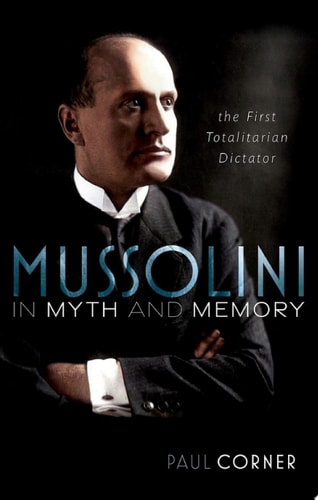
Mussolini in Myth and Memory: The First Totalitarian Dictator
0
0
As an Amazon Associate and affiliate partner, Menrva Books earns from qualifying purchases. Learn more
Author Description
Mussolini in myth and memory. Paul Corner looks at the brutal reality of the Italian dictator's fascist regime and confronts the nostalgia for dictatorial rule evident today in many European countries. Mussolini has rarely been taken seriously as a totalitarian dictator; Hitler and Stalin have always cast too long a shadow. But what was a negative judgement on the Duce, considered innocuous and ineffective, has begun to work to his advantage. As has occurred with many other European dictators, present-day popular memory of Mussolini is increasingly indulgent; in Italy and elsewhere he is remembered as a strong, decisive leader and people now speak of the 'many good things' done by the regime. After all, it is said, Mussolini was not like 'the others'. Mussolini in Myth and Memory argues against this rehabilitation, documenting the inefficiencies, corruption, and violence of a highly repressive regime and exploding the myths of Fascist good government. But this short study does not limit itself to setting the record straight; it seeks also to answer the question of why there is nostalgia - not only in Italy - for dictatorial rule. Linking past history and present memory, Corner's analysis constructs a picture of the realities of the Italian regime and examines the more general problem of why, in a moment of evident crisis of western democracy, people look for strong leadership and take refuge in the memory of past dictatorships. If, in this book, Fascism is placed in its totalitarian context and Mussolini emerges firmly in the company of his fellow dictators, the study also shows how a memory of the past, formed through reliance on illusion and myth, can affect the politics of the present.
Menrva's Summary
THE THESIS
This book investigates why the historical reality of Benito Mussolini’s brutal regime is increasingly obscured by modern nostalgia for authoritarian leadership. Paul Corner, a historian specializing in Italian Fascism, utilizes archival evidence and historical analysis to dismantle the myth that Mussolini was a benign or effective dictator compared to his contemporaries. He argues that the current rehabilitation of Mussolini’s image is a symptom of a broader crisis in modern Western democracy, where citizens seek refuge in the illusion of strongman governance.
THE SCOPE MAP
What You Will Find
- An examination of the corruption, violence, and systemic inefficiencies inherent in the Italian Fascist state.
- A comparative analysis placing Mussolini within the context of 20th-century totalitarian dictators.
- A psychological and political exploration of why collective memory often favors myth over historical fact.
Scope Limits
- The text does not provide a comprehensive chronological biography of Mussolini’s entire life.
- It does not focus on the military strategy of World War II, prioritizing internal regime dynamics instead.
THE AUTHORITY PERSPECTIVE
Historians and political scientists recognize this work as a critical intervention in the study of historical memory and the resurgence of authoritarian sentiment. Readers frequently note the clarity of the prose and the author's success in bridging the gap between past political realities and contemporary political discourse.
Page Count:
191
Publication Date:
2022-01-01
Publisher:
OUP Oxford
ISBN-10:
0192691902
ISBN-13:
9780192691903
History
Biography
Europe
Fascism
European History