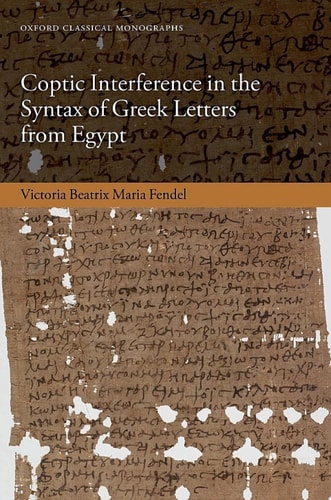
Coptic Interference in the Syntax of Greek Letters from Egypt
0
0
As an Amazon Associate and affiliate partner, Menrva Books earns from qualifying purchases. Learn more
Author Description
Egypt in the early Byzantine period was a bilingual country where Greek and Egyptian (Coptic) were used alongside each other. Historical studies along with linguistic studies of the phonology and lexicon of early Byzantine Greek in Egypt testify to this situation. In order to describe the linguistic traces that the language-contact situation left behind in individuals' linguistic output, Coptic Interference in the Syntax of Greek Letters from Egypt analyses the syntax of early Byzantine Greek texts from Egypt. The primary object of interest is bilingual interference in the syntax of verbs, adverbial phrases, clause linkage as well as in semi-formulaic expressions and formulaic frames. The study is based on a corpus of Greek and Coptic private letters on papyrus, which date from the fourth to mid-seventh centuries, originate from Egypt and belong to bilingual, Greek-Coptic, papyrus archives.
Menrva's Summary
THE THESIS
This study investigates the extent and nature of Coptic linguistic interference within the syntactic structures of Greek private letters written in Egypt during the early Byzantine period. Victoria Beatrix Maria Fendel, a specialist in classical philology, utilizes a corpus-based approach to examine how bilingualism influenced the written output of individuals in a contact-heavy environment. The work argues that syntactic shifts in verbs, adverbial phrases, and clause linkage provide clear evidence of cross-linguistic influence between Greek and Coptic.
THE SCOPE MAP
What You Will Find
- Analysis of syntactic interference in verbs, adverbial phrases, and clause linkage.
- Examination of semi-formulaic expressions and formulaic frames in papyri.
- Corpus-based methodology focusing on bilingual Greek-Coptic papyrus archives.
Scope Limits
- The study is restricted to private letters from the fourth to mid-seventh centuries.
- It does not cover literary or administrative texts from the same period.
THE AUTHORITY PERSPECTIVE
Scholars in the field of papyrology and historical linguistics recognize this monograph as a rigorous contribution to the study of language contact in late antiquity. Readers frequently note the technical precision of the syntactic analysis and its value for understanding the linguistic reality of Byzantine Egypt.
Page Count:
550
Publication Date:
2022-01-01
Publisher:
OUP Oxford
ISBN-10:
0192695835
ISBN-13:
9780192695833
History
Linguistics
Ancient History
Papyrology
Language Contact
Community Tags
Other Editions(3)

Similar Books